Seeing in part

FullSizeRender (4)

The questions keep coming!

This past Sunday I responded to these questions (pictured above) by sharing the following story: THE BLIND MEN AND THE ELEPHANT

To me this story is another way of saying this: “For now we see in a mirror dimly, but then face to face. Now I know in part; then I shall know fully, even as I have been fully known.”  (1 Corinthians 13:12) In other words, when we set out to know or describe Truth/God, we do so based on so many factors (context, background, age, sexuality, life experiences, social location, demographics, etc.) We might see/describe part of the whole, but we also have blindspots. As I told the children on Sunday, sometimes we need others to help us fill out who God is/isn’t. What Dale Graham heard me say is this:

“I think I got it, Ruth. God is an elephant and we are all blind.”

I’m glad (I think) that adults are listening during the time with children.

Now to the question about God’s gender. I was asked recently what pronouns I use when referring to God. I’ll be brave and give my off-the-cuff response which was recorded verbatim:

“I do not use “he.” I also do not use “she” typically. I try to get more creative than that, recognizing that my views of God are way beyond just a gender or even a physical being. I love looking through hymnals and finding the variety of words given to the Divine. Words that are so much richer than “he” or “she” could ever be. I think of mystics like Hildegard of Bingham who provide a whole treasure trove of words for the divine such as “Root of Life,” “Creator.”

When I baptize I say, “Creator, Redeemer, and Sustainer.” “Divine One.” “Holy One.” I often use “Holy One.” “Shepherd,” of course. “Mother Hen.” We have such impoverished names for God. We just use default names without ever really thinking about what else is possible. I make a deliberate choice to stay clear altogether of gender-bound pronouns for God.

If you want to do some additional reading on inclusive language for God, here are a few quotes from a worksheet that was given to me at seminary. I’m afraid I don’t know who authored it, but I think it’s an excellent piece.  Here are just a few quotes from it:

“Why do I try to use inclusive language consistently?…In a nutshell: it is because I am aware that all language concerning God is metaphorical language (that is, analogical, only partially and modestly appropriate to name or to refer to the Holy One); noninclusive language is inherently restrictive and reductive, at least to the extent that it is considered as the norm.

“If I can learn to use more inclusive language in reference to God then I also can [and I should] learn to use inclusive language in other significant areas which call for inclusive language…that is, I can [and should] develop a habitus for welcoming inclusiveness.

“Human language cannot comprehend the unfathomable mystery of God…I must be careful not to assume that my/our ways of naming and talking about God are comprehensive enough and sufficient (that is, I am always subject to correction and enrichment in this area)….

“We need each other and especially those different from us to get further glimpses of the reality of God and to discover and practice alternative and appropriate ways of talking about such a reality.

“Our knowledge of God is precarious, paradoxical, and prayerful, so I need to be open to corrections and to more truthful alternatives.

“When all is said and done, the key question is not whether I am theologically (or politically) correct concerning language for God; the question is whether my language reflects and contributes to growth in the knowledge and the love of God, both in myself and also in others; that is the heart of the matter!


Posted in Uncategorized | Leave a comment

The place of the dove

IMG_1167

Our Lenten question box

At Rainbow our young congregants are encouraged to pay close attention to what they are hearing, seeing, and sensing. The children’s attention and observations are evident in the questions that keep appearing in our Lenten question box. Click here to read their growing list of questions: Questions for Lent

Knowing that children (and adults I hope!) are listening intently and asking questions makes me want to give extra care to my responses.

So let’s look again at this question about the dove (see above). Doves are often thought to be peaceful, meek, mild, innocent, and harmless creatures. So what does it mean to adopt this docile creature as our Mennonite mascot?

mcusa-long-color

It’s a nice-enough image. It’s simple, it has energy, it feels organic, and somehow less stately, dramatic, and institutional-looking than some of these other denominational images.

This slideshow requires JavaScript.

That being said, some days I wish our Mennonite dove/church had a little more dramatic  flare. After all, Jesus not only commissioned his disciples to be innocent as doves, but “wise as serpents” (Matthew 10:16).

I often think of this passage from Matthew as I stand behind our new pulpit, which not only has a dove on the front of it, but the whole pulpit is shaped like a dove in flight. Here it is in the mid-afternoon, getting its daily sun bath.

IMG_1006

It’s not evident in this picture, but the seven leaves (seven being a symbolic number meaning fulfillment) are made of Lignum Vitae, which in Latin means tree of life. This rare and beautiful wood is known to be some of the heaviest and hardest wood in the world, having mild-perfume-like fragrance and many medicinal uses. This is so fitting given the reference in Revelation 22:1-2: “Then the angel showed me the river of the water of life, bright as crystal, flowing from the throne of God and of the Lamb 2through the middle of the street of the city. On either side of the river is the tree of life with its twelve kinds of fruit, producing its fruit each month; and the leaves of the tree are for the healing of the nations.”

And so getting back to the question at hand: Why do Mennonites use the dove symbol? I hope that our Mennonite dove symbol is not so much a badge of honor, as if we are the innocent doves in the world, as much as a reminder of the “things that make for peace” (Luke 19:41). I hope that we are among those poised to take flight, working  with wisdom, strength, and perhaps even some flare for the healing of the nations.


Posted in Uncategorized | Leave a comment

The place of the cross II

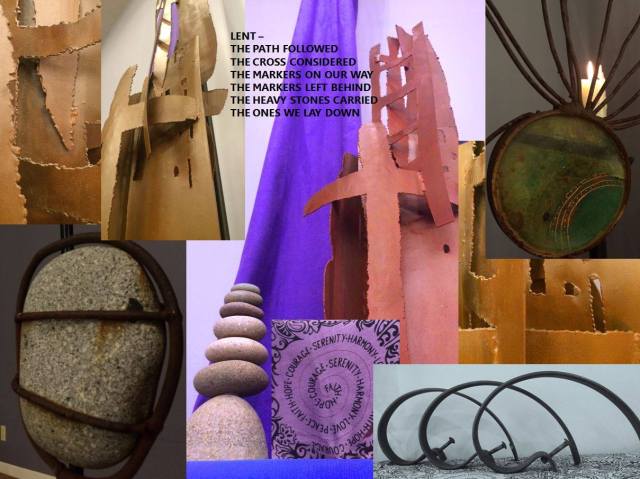
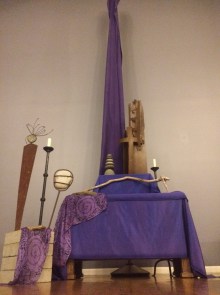
On Sunday, February 14 I saw a group of K-5th graders with paper and pen in hand huddled around this Lenten display at the front of our sanctuary. It was the WorshipArts group drawing what they saw. The following Sunday I saw church member Lonnie Buerge taking close-up pictures of this same display. What follows is the result of these creative projects/souls.

IMG_1073


This slideshow requires JavaScript.

920725_10207304516585972_6615186628017031677_o

Lent—
The path followed
the cross considered
The markers on our way
The markers left behind
The heavy stones carried

-Jan Buerge

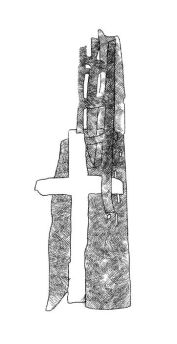
Speaking of creative projects and souls, here is a recent piece of writing about our Lenten metal cross sculpture from Sue Regier:

cross sketch

Sketch of Arlie’s piece by Jesse Graber

“That sculpture was made as a summer teenage Sunday School project. The classes were held upstairs in  the church at first, led by Arlie (Regier). Designs of a religious significance were drawn on paper and then cut out to be fitted together. Eventually, the group moved outside to the park to meet. Arlie brought the sheets of steel, the welder, gas cylinders, many pairs of goggles plus other supplies. When the group decided on what designs were  to be used, they were outlined on the  sheets of steel and cut out by the welder. Students, plus neighborhood  folks, all with goggles on, watched as Arlie welded the pieces together to make a sculpture. The welds were relieved of the slag with sandpaper and hammer and chisels. The finish was attained with water. It needed to rust. The final finish of clear automotive top coat paint was applied. This happened during the 1980s. For one  summer, rough edges and fire somehow came together for a few young people of The  Book.”
-a witness, Sue  Regier

I’d say these artists, builders, poets, and writers have already enriched our Lenten season!


Posted in Uncategorized | Leave a comment

The place of the cross

A couple weeks ago the Rainbow choir sang these words prior to our monthly communion service: “Here are symbols to remind us of our lifelong need of grace; here are table, font, and pulpit; here the cross has central place.”

I had to smile when thinking about that last phrase.  Currently a cross does not hang permanently front and center in our sanctuary. That has not always been the case. Just look at Rainbow worship space through the years:

This slideshow requires JavaScript.

Here is the front of the sanctuary today (the visuals change with the seasons):

IMG_1073

The cross symbolizes and evokes different things for different people. I went through a phase in college when upon seeing someone wearing a cross necklace, I felt physically upset and wondered why on earth anyone would wear a torture device around their neck?! After all, that is what the cross represented for Jesus—it was the equivalent to our modern day electric chair. Now, more than 10 years later, I seem to be in the business of collecting crosses (occupational hazard I suppose.) Just look at this cross variety found in the pastor’s office:

“What does the cross do?” asked a young girl at Rainbow recently.  She didn’t ask what it is, but what it does. What a question?!

Perhaps we can all think about what our answer might be to this wonderful question as we approach the second Sunday in Lent. And while you’re at it, how would you answer these questions?

  • In what ways is the cross central/not central in your life and faith?
  • In what ways is the cross central/not central in our life together at Rainbow?
  • And how would we know if and when the cross is central, whether permanently displayed or not?

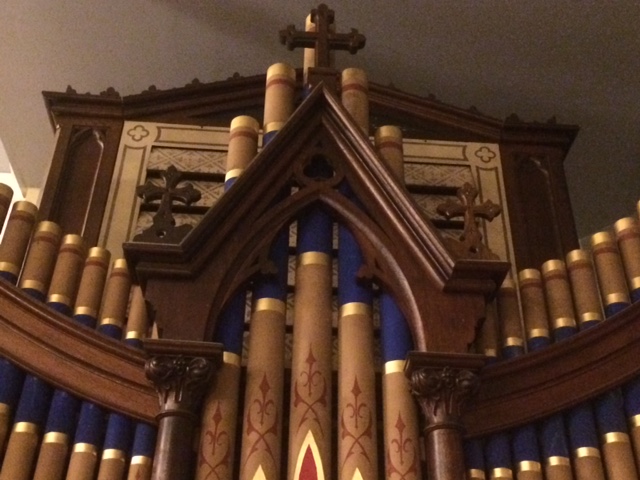
And lest anyone accuse Rainbow of not having the cross permanently displayed in our sanctuary, there are actually three crosses  attached to the top of the organ, but I doubt if many people at Rainbow know this….maybe not until now.

IMG_1074


Posted in Uncategorized | Leave a comment

Feel the burn

No, this blog post isn’t an endorsement for Bernie “feel the bern” Sanders.

It is an endorsement for the season of Lent and Ash Wednesday in particular.

I know not everyone at Rainbow can endorse Lent/Ash Wednesday. Some people experience Lent as a morbid part of the church year with talk of giving things up, sin, and sacrifice. And yet for others Lent is a time of great renewal, awakening, or as someone once put it while waiting to receive ashes, “I never feel so alive than on Ash Wednesday.”

Last Sunday our Rainbow WorshipArts group got a head start on Lent by going outside to burn the Palm Sunday branches from last year. They did this in the Rainbow Remembrance Garden, an appropriate place to reflect on beginnings and endings.

The children had a lot of questions, including one many of us ask this time of year:

Why ashes? 

I wasn’t with the children during this burning activity, so I’m not sure how I would have responded to their questions. I might have mentioned that in Genesis 18:27 and Job 30:19, dust and ashes are mentioned as components of the human body. Furthermore, in Jewish and Christian history, ashes are a sign of mortality and repentance: Mortality, because when we die our bodies return to the dust and ash of the earth. Repentance, because in ancient times when people felt remorse for what they had done, or sorrow in the face of grief, they would put ashes on their head and wear sackcloth.

Obviously you won’t see this pastor or anyone for that matter walking around in sackcloth, at least not if I/we can help it. But you might see people with an ash marking. I’d encourage everyone to be curious about people’s reasons for participating in such a ritual. And I’d encourage you to be reflective about your own reactions/meaning- making around this ritual.

Everyone has their different reasons for participating or not participating in this ritual. For me, as I give and receive ashes this year, I will probably have in mind the following reflection by my friend John Bergen. I will be asking myself what I’m willing to put on the line for my faith. I will be praying for courage in the face of dust.

From John:

Hey y’all, its the week of Fat Tuesday and Ash Wednesday, the start of Lent! My favoritest time of the Christian calendar! I’ve been thinking about this time, marking the transition from Jesus’ base-building in northern Palestine to leading the march on Jerusalem. We prepare for a week of direct action (Holy Week), culminating in mourning a state murder and celebrating God’s overcoming of the death and imperial death culture. Its a lot!

A lot of us who were raised Christians were/are asked to “give something up” for Lent – chocolate, alcohol, whatever. On the flip side, I often here Christians talking about “adding something extra” for Lent – more intentional prayer practices, more service to the poor, etc. These are both fine, but I don’t think that was Jesus’ message. As we celebrate the duality of Fat Tuesday and Ash Wednesday this week, I’m remembering that its not about contrasting hedonism and asceticism, but rather treating ourselves in joy and celebration, and then asking ourselves what we’re willing to put on the line for our faith. When Jesus talked about giving up, he wasn’t talking about shrinking ourselves or our habits, he was asking us to be brave.So much of the rhetoric around Lent can be a mask for conversations about privilege – I should consume less, serve more, be somber about suffering, etc. But what are we willing to put on the line? What can we give for our movements? This may be us consuming less, or giving more, or it may be us doing less activism and taking care of ourselves. Maybe it means having hard conversations with friends, or speaking the uncomfortable things we hold inside. So many things.

All are invited to Rainbow for a contemplative Ash Wednesday Service February 10, 5:45-6:30 pm.  And for those interested in other Lenten services/activities at Rainbow, click here: Lent information

Posted in Uncategorized | Leave a comment

Do Justly. Love Mercy. Walk Humbly.

Thank you to Rainbow Youth Program Director Renee Reimer for this Micah 6:8 reflection. Renee submitted this right before leaving on a two-week immersion course in the culture, faith and sites of Egypt.

He has told you, O mortal, what is good; and what does the Lord require of you but to do justice, and to love kindness, and to walk humbly with your God?

Immediately, the sounds of Patty Shelly’s voice runs across my mind as she sings, “God has shown you, oh people, what is good. And what does the Lord require of you. But to do justly, love mercy, walk humbly with your God.”(Micah Song by Patricia Shelly)

I first heard this song sitting in chapel my freshman year at Bethel College and was amazed at how being able to sing this text brought a whole new meaning behind Micah 6:8.

If you know me well, you know that my passion for the love of the world is great, almost too great in some cases. My mind often lives in this utopia world where all races, religions, and cultures live together in peace and harmony. A world where there is a roof for every human being and everyone has enough food on their table. I was once told that this “utopia world” dream I have was unrealistic. In my head I was thinking, “well I will show you!” On the outside, I smiled and tried to show a little love. But folks, there is a fire in my belly that will not rest until this corrupt world walks together. One day I will figure out how to support myself by traveling the world singing songs of love and peace and the world will see that this life is possible.

I felt this fire for the first time 5 years ago on my trip to Israel/Palestine. Amidst the conflict, I heard stories of people saying they do not have the privilege of losing hope. “Our blood is the same color. Our pain is the same pain.” How can I then, someone so sheltered and privilege, lose hope?  Following this life changing journey to the Holy Land I came across the script, My Name is Rachel Corrie, which consists of writings by Rachel Corrie, a peace activist who worked in Gaza. Rachel Corrie’s words gave a voice to the feelings I had no idea of how to express.

“For a long time I’ve been operating from a certain core assumption that we are all essentially the same inside, and that our differences are by and large situational. I know there is a good chance that this assumption is actually false. But it’s convenient, because it always leads to questions about the way privilege shelters people from consequences of their actions. It’s also convenient because it leads to some level of forgiveness, whether justified or not.”
– Rachel Corrie

SWM_9893I had the honor of sharing the collection of Rachel Corrie’s words with others in January of 2013, two years following my return from the Holy Land, and the following summer on a special tour to various churches and the MCUSA convention. I tell you all this because this was my journey to permanently having this text engraved on my foot, my broken foot for that matter.


This tattoo is my constant reminder to not loose hope despite school, work, life, and the everyday struggles I may face in life. This is a reminder that with every step I take, to do so with love. To step humbly on this journey. To constantly seek the justice of the world, beyond the daily tasks I have laid out in front of me.

At the end of a long day, I take off my socks and see this text and think, tomorrow is another day to practice spreading hope, love, and peace. The word practice implies with intention, not perfect, so that I may continue to strive to spread that love.

As I embark on my next journey overseas I not only carry these words in my heart, but also on my walking foot.

Our first task in approaching
Another people,
Another culture,
Another religion,
Is to take off our shoes,
For the place we are approaching is Holy.
Else we may find ourselves treading on people’s dreams.
More seriously still, we may forget that God was there before our arrival.
Take Off Our Shoes by John Taylor, 1992

Forever practice doing justice, loving kindness, and walking humbly with God.

Now I must find a way to talk about this tattoo with 3 year olds who have asked why I have those black lines on my foot…

Posted in Uncategorized | Leave a comment

A year of mercy

Diane

We continue our series of reflections on Micah 6:8. Here is a reflection from Diane Richardson Spaite.

He has told you, O mortal, what is good; and what does the Lord require of you but to do justice, and to love kindness, and to walk humbly with your God?


Confession: I started singing about “doing justice, loving mercy and walking humbly” with many other Steven Curtis Chapman fans who loved his song “The Walk” when it was released in 1996. While the 90’s pop Christian hit admittedly had catchy feel, there was something about the words which evoked a sobering reverence within my 15-year old being.

For as long as I can remember there’s been a yearning deep within me to surround myself with people who can teach me about justice. It’s mattered so much to me at times I’ve even put myself in the judge’s seat, assuming I know the absolutes about complex world issues or earthy human relationships. In an effort to earn my own righteousness rather than welcome others, I’ve often put intentional distance between myself and anyone I perceived as having wealth, power or affluence.

However, in the past year, my life has taken a surprising turn. Unexpected medical concerns and limited job possibilities in my fields of interest/passion landed me in a full-time job for what I would consider “corporate America,” interacting regularly with those whose primary motivator is financial gain. I’ve gone from working solely in urban areas among families struggling to make ends meet to being surrounded by people who have intentionally made choices to remove themselves from being reminded others live in poverty. This abrupt change has brought deep grief but it has also pushed me to seek God in new ways and to dig deeper into the well of mercy I find myself so desperately in need of.

Mother Teresa says this: 

We have no right to judge the rich. For our part, what we desire is not a class struggle but a class encounter, in which the rich save the poor and the poor save the rich.  -Mother Teresa (2010-10-04). No Greater Love (pp. 97-98).

Thankfully, along the way I’ve had the gift of a regular prayer companion who I connected with through the Ignatian Spirituality Center here in Kansas City. The center is focused on spiritual direction, following in the ways of Ignatius and learning to find God in our everyday lives. Through this experience, I sense something beginning to shift within my relationships with my co-workers and interactions with wealthy clients. I’m starting to feel less inclined to climb up in the judge’s chair and a softening in my spirit.

I believe both the rich and the poor are created in the image of God. And as someone who was born into this world with privilege in ways I never chose for myself, I am really hopeful God’s mercy is also for me. This year the Pope has declared it to be a global year of Jubilee. In the Pope’s 12-page paper called “The Face of Mercy,” he says:

And, what is it that ‘God likes most?’ Forgiving his children, having mercy on them, in order that they may, in their turn, forgive their brothers and sisters, shining as torches of God’s mercy in the world…

These words have brought me hope and encouragement to continue to persist in love looking for ways in which I can participate in God’s restorative justice, refining mercy and revolutionary humility smack dab in the middle of a company working towards the creation, protection and increase of personal wealth. The profoundness of scripture and the prophets to me is this: along with the wake-up call delivered to the people, there is always a redemptive path to bring the people back to right relationship and communion with Love. The judge and Micah, as spokespersons for this mysterious God, speak with purifying conviction and simultaneously offer a gracious invitation of restoration. If God is truly about redemptive justice in the world, and we are invited to participate, then it only seems fitting we may find ourselves in the oddest of places, creating outposts of invitation even for those who appear to have it all.


Posted in Uncategorized | Leave a comment

How Much Justice Is Enough?

What follows is Joshua Chittum’s Micah 6:8 reflection:

He has told you, O mortal, what is good; and what does the Lord require of you but to do justice, and to love kindness, and to walk humbly with your God?

Last week I toured the United Nations Headquarters in New York City before attending a work conference in the heart of Manhattan. Within the UN’s vast complex our tour guide lead us through an exhibit that spotlighted the injustices of the world – military expenditures dwarfing humanitarian aide, the fact that it is cheaper to take a life with a landmine than to save one from the same device, artwork from the Arab world highlighting the beauty of cultures outside our own, while fearmongers ravish the senses.

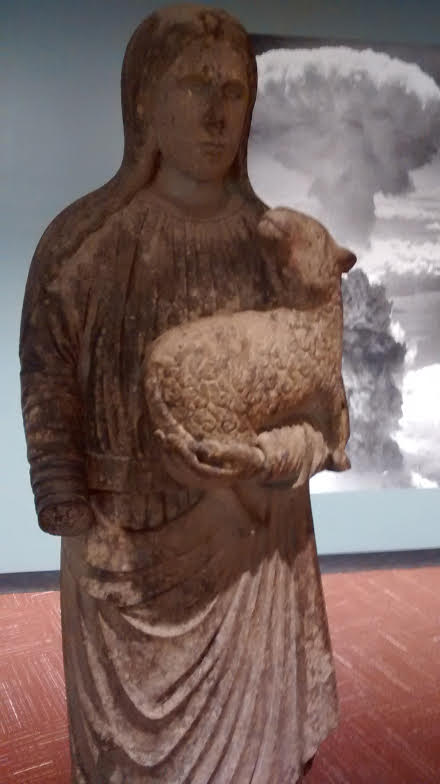
Displayed on a black pedestal, standing with the weight of witness on her shoulders, was Saint Agnes who was discovered beneath the rubble of a cathedral destroyed by the Fat Boy bomb in Nagasaki. Her entire backside from head to toe was charred and molted. I looked into her eyes and tried to imagine the unimaginable. Feel the force of the shock wave that knocked her to the ground. See the sacred space crumbling around her. Touch the heat of her enflamed exterior.

-1

I longed to stay in her presence – this representation of destroyed lives, of decimating the sacred, of pure injustice. But the tour guide ushered us along and time would not allow me to stand face to face with her any longer. It’s just like life. Take a fleeting look at injustice and then move on as if nothing happened. But that day, standing beneath a stone saint, a tantrum began to brew that was not satisfied with pushing aside all the pain of the past and the present.

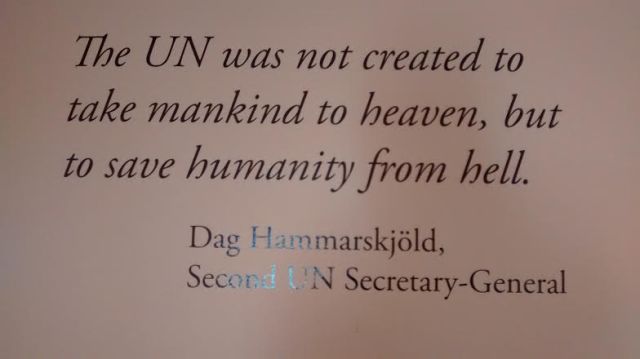
Intensifying my temper was a quote by a former UN General Secretary. Painted in black letters on a white wall it stated the mission of the UN not “to take humanity to heaven, but save humanity from hell.” The hurt of the words slowed my step. Though I cannot succinctly define justice, merely avoiding hell does not come close to sufficiency.

-2

Prone to slide into places where there is more darkness than light, my mind did just that. I thought of the people in the world and their individuals hells. The wars. The bombs. The landmines. The limbs missing. The fleeing. The drowning. The hate. I then thought of the families and children experiencing homelessness that I work with in my day job. I thought of their struggles. The mental illness. The violence. The addiction. The hopelessness. And I began to agonize over whether we have succeeded in saving humanity from hell.

This angst and obsession stayed with me throughout my time in New York. I struggled with feelings of ineptness in my role, in my organization, my community, and this world. The face of Saint Agnes stared at me as I wandered the city streets. She spoke to me. She told me to do something, to throw a tantrum if I must. Just as long as I didn’t allow that moment standing before her to become fleeting, to become forgotten.

Meanwhile, I tried to focus on the learning I was sent to do at the conference. But the injustice of children seeing their dreams disintegrate through no fault of their own kept spinning in my heart and mind. The absurd shortcomings of our actions dug its way into my ear and played an unsettling tune. The lavish fundraisers. The Christmas present hand outs. The warm fuzzies for those privileged to feel them in their bellies. The non profit industrial complex.

So very little of any of this creates justice. So few lives are allowed to live according to their dreams. There’s just the monotony of derelict lots and police chasings. Of lost hope and a competition for the one who hurts the most. I swore at the bromides to get through the day. I don’t care about a single starfish any longer. I only care about the millions dying along the shore. I don’t care about the planting of one, little seed. I only care that so much land is barren to begin with.

Listening to all this in my mind – stuck in a city not known for its tranquility – my clinical anxiety pinned me to the mat. Fantastical worries about evil gods and falling worlds, the mirror reflected nothing but weakness and impotence. How can I move a grain of sand, yet alone come up with a plan that will act for true justice, rather than spin in place inside a rusted, wired wheel?

I returned to Kansas City drenched in hopelessness. I continued my work on this blog. I rewrote it. I overwrote it. I wrote it again. The message remained vaguely defiant, yet helpless without a plan, except my desire to rage.

Still, there was a deadline and though I wasn’t completely satisfied in them, I shared the words. In return, I was heard. And comfort was shared with me. It took a few days, but that simple act placed a candle back in my hand. The wick is still not lit. But it was the mercy of another that gave me back what I had dropped. And without that mercy, I’ve realized there can be no justice.

This struggle over the last few weeks stemmed from a place I could not identify until I heard a quote this morning on the On Being podcast. Host Krista Tippet, talking to a secular Buddhist, quotes Rabbi Abraham Joshua Heschel as saying,

“I would say about individuals, an individual dies when he ceases to be surprised…When I see an act of evil, I’m not accommodated… I’m still surprised. That’s why I’m against it, why I can hope against it. We must learn how to be surprised. Not to adjust ourselves. I am the most maladjusted person in society.” (You can listen to the full episode here: The Spiritual Audacity of Abraham Joshua Heschel.)

I fear that someday I will become well adjusted to injustice. I fear that with that adjustment I will no longer be able to act for its demise. I fear that Saint Agnes’ face will be forgotten. I fear that I will give up when the world seems less interested in ending justice and more interested in pleasures. Mercy was the only way to help me through this.

Even if we have failed or fail in the future and find ourselves in the darkness of hell, only together can we find stones to strike and create a spark for light. With that light comes the hope that even if everything we did was wrong today, tomorrow we may be grow closer to getting it right.


Posted in Uncategorized | 5 Comments

Pageants and Micah

Thank you Dawn Araujo-Hawkins for this reflection on Micah 6:8. Dawn is a staff writer based at the Global Sisters Report headquarters in Kansas City, Mo. Before coming to Global Sisters Report, she was a freelance religion reporter and had also worked as the editorial assistant at Sojourners magazine. She has a journalism degree from Ball State University and a master’s in religion from Cincinnati Christian University

He has told you, O mortal, what is good; and what does the Lord require of you but to do justice, and to love kindness, and to walk humbly with your God?

People are sometimes surprised to learn that I was once a pageant girl. To a good portion of the people I’ve known (outside of the pageant world, that is) beauty pageants are associated with an inherent vapidity and that I — a social justice-loving feminist and seminary-educated journalist — just do not possess.

pageant 1

Dawn right after placing first-runner up at Miss Ohio International in 2011.

“It’s a good thing you’ve moved past that stage,” they’ll say, laughing and rolling their eyes. I always get the feeling that what I’m supposed to do next is disavow my shameful past, to slam pageants as this archaic culture I was lucky to escape.

But here’s the thing: I still love pageants.

Not only that, I attribute the vast majority of my personal and professional growth to pageants. It is with the utmost certainty that I say I would not be the journalist or activist I am today if my 9-year-old self had not decided she wanted to be Miss Indiana.

Ruth asked me to reflect on what pageants taught me about the prophet Micah’s exhortation to act justly, love mercy, and to walk humbly with my God. I told my sister (also a pageant girl) about this, and we both had the same reaction: what didn’t pageants teach us about justice, mercy, and humility? I could probably write a book about this, but Ruth also asked me to be brief, so here’s the Cliff’s Notes version of how pageants have informed what Micah 6:8 means to me.

pageant 2

The first time Dawn and her sister won pageants at the same time. Dawn was Miss Indiana American Coed 2006, and her sister was National American Miss Indiana Teen 2006.


Act Justly

As a young girl, I don’t think anything overtly tested my sense of integrity like pageants. Now, I know I just sang the glory of pageants, so it might sound like I’m backtracking here, but bear with me. I promise I’m not changing my tune.

The essential purpose of a pageant is for an organization to pick someone to be its public face. The organization says these are our values, and then women and girls who think they epitomize those values partake in a variety of competitions to prove they are, indeed, what the organization wants. Pretty simple.

However, in some instances, a woman just wants to win a crown, so she will lie about all kinds of things just to seem like the “right” girl. One of the most conspicuous (albeit largely benign) examples of this is when contestants take a few weeks of voice or dance lessons just so they can do a pageant with a talent competition. In more dramatic instances, women fabricate paperwork or outright lie about life experiences.

I learned early on that I was not interested in pretending to be someone I wasn’t just to win a crown. I remember that even as a 15-year-old, I refused to give politically correct answers in pageant interviews — once schooling a panel of judges on #blackgirlmagic when they had wanted to me bemoan my own identity.

Having to routinely stand up for what I believed in as an adolescent — even when it meant risking my chances of success — primed me for social justice advocacy as an adult. Any time I’ve led a protest or joined in an act of civil disobedience, I’ve drawn on my pageant experiences.

Love Kindness

Pageants get a lot of flack for pitting women against each other, which is true in a sense. I mean, women in the WNBA also compete against each other, but there’s something different about a competition as subjective as a pageant; the competition feels more personal — but that’s why I think pageants are such an amazing example of mercy and kindness.

Contrary to the stereotypes, pageant girls are some of the most kind and caring people on the planet. Case in point: when my sister had a kidney transplant in 2005, pageant girls were among the first to call and visit her in the hospital. Ten years later, when my sister needed a second transplant, pageant girls we hadn’t seen in years were among the first to get tested as matches.

pageant 3

Picture taken at a fundraiser for the National Kidney Foundation in 2006 with Brittany Luther, Miss Carmel Indiana American Teen 2006.

I’ve certainly met catty and mean girls at pageants, but they are the exception to the rule. In my experience, most pageant girls genuinely root for and support each other.  That’s why at the end of televised pageants, you usually see all the contestants run up to the winner to hug and congratulate her — the woman who just realized their dream. Pageants are a supportive family, and being a part of that teaches you a lot about loving others.

 Walk Humbly

Pageants are also a crash course in humility. For one thing, no matter how good you are, you don’t always win. There’s a saying in the pageant world that on a different night, with a different panel of judges, the results could have been different — and it’s true. By the time I was 19, I had won five Miss Indiana titles, but I could never assume that any given crown was mine to take. I always had to practice. I always had more to learn. I always had to grow. In fact, the few times I did get cocky and start to believe I knew everything there was to know about pageants, I lost. Badly.

Yet even winning a pageant can be an ego check. Becoming Miss Pageant Winner means you instantly become the public face of an organization. Now, for better or for worse, everything you say, tweet, wear, or even listen to on Spotify can be scrutinized as a reflection of the organization you represent, so you constantly have to be thinking about others and not just yourself.

(I also learned you can also still fall off the stage as a pageant winner, but that’s a story of humility for another time and place.)

Pageants are strange in that you must be filled with humility while simultaneously exuding queenly confidence. But I like to think that’s a microcosm of sorts for the dichotomy of humanity; we are made in the image of a supremely holy God and yet we are sinners in need of mercy and grace. It’s a tricky line for anyone to walk, but pageant girls have extra practice.

So that, in less than 1,000 words (boom!) is what I’ve got about pageants and Micah.

Of course, pageants are not for everyone; my experience was amazingly beneficial, but that’s me. There are also lots of pageants out in the world, and not every pageant is suitable for every person. I don’t want to imply that pageants are a necessity to a girl’s development, but I do want to suggest that they can be if you let them. They can teach you a lot about God and about yourself.

pageant 4

Dawn (left) as Miss Indiana National American Miss 2008 and her sister (right) as Indiana’s Teen 2008, visiting the Indiana State House to meet the governor.

You can read another written piece by Dawn by clicking here: Feeling inappropriate in yet another time of tragedy. 
Posted in Uncategorized | 3 Comments

Living Large: A reflection on Micah 6:8

For the next several weeks, folks from Rainbow will be offering short reflections on Micah 6:8: He has told you, O mortal, what is good; and what does the Lord require of you but to do justice, and to love kindness, and to walk humbly with your God?

Homesweethome

Terry Rouse in front of the tiny house he built and lives in.

My question to Terry Rouse was this: How does Micah 6:8 fit with the way you live your life?

Here is his response along with some photos and captions from me.

Act justly
The first word that comes to mind is fairness. Fairness with those with whom I have interactions is the first layer. But fairness with those I will never know brings up a deeper question for my life. How I live my life affects people all around the world and people yet unborn. How can I reduce my footprint on this earth?  Meat production consumes a lot of water and energy so I moderate my consumption of meat. If I can, I ride my bike or take the bus. I also carpool when I can, but I still drive much more than I want. There are days when I succumb to the comfort and convenience of driving.  I built the smallest house that would provide for my daily life. It gets all of its electricity from the sun. It has a composting toilet and that helps keep my daily water consumption at around 5 gallons a day. It has a solar water heater that provides my hot water on sunny days. It has South facing windows that keep it warm (so far) on sunny days. I do use propane for heating and cooking. I am looking for ways to reduce that. Whenever the sun is shining I feel blessed.

This slideshow requires JavaScript.

Love mercy
To me this means to live in a state of forgiveness. It is the hardest of the three for me. It is hard enough for me to forgive others, but often I find it harder to forgive myself. I have started to notice that sometimes when I am angry at someone, it is often a mirror of anger I have towards myself because I did not do a good job of taking care of myself.

Walk humbly

I was raised to be independent and self reliant. There may be some virtue in that, but it leaves a hole in my heart. It leaves no place for gratitude. I bought a trailer on which to build my tiny house with no idea of where I would put it when it was finished. Within the first week of buying the trailer I had two offers. I had several other offers, but ended up leaving it in the parking lot where I built it because the Arts Asylum has been so supportive and it had better solar access than the other sites. Being in a place of vulnerability and receiving kindness has introduced me to the joys of gratitude.

You can learn more about Terry’s house project by clicking on the following links:

http://www.kansascity.com/living/home-garden/article23435838.html

http://meredithaz.worldnow.com/story/29086047/pint-size-trend-tiny-house-movement-reaches-metro


Posted in Uncategorized | Leave a comment