Our new worship series, which we will begin January 15, will focus on what it might mean to be Mennonite/Anabaptist. I get monthly calls/emails from people asking me this very question, so I figured it was time to explore this question in preaching, and over several weeks.
In preparing for this series, I looked for some kind of Mennonite-related visual or symbol to showcase. This may surprise some considering that Mennonite congregations have held widely divergent attitudes toward the use of visual symbols in worship. Obviously at Rainbow we embrace use of visual arts in worship, as you can see on this page of our website: Visual Arts at Rainbow.
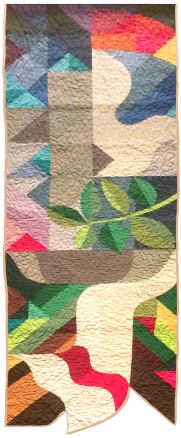
As my search for visuals continued, I remembered the quilted banner that my good friend Sarah Klaassen, pastor of Rock Bridge Christian Church in Columbia, MO, had hanging at her ordination last year (pictured to the right). Thankfully, Sarah (and the church) agreed to loan Rainbow this banner for the next month and a half.
Here is Bob’s description of this particular banner:
Title: Peace and Service
Perhaps there is no more familiar symbol of service within the Mennonite church than the logo of the Mennonite Central Committee. So I have given this symbol, composed of the cross and dove, a prominent position in the upper third of the banner. There is a circular motion around this symbol that alludes to the orb, or world. This witness through service is not restricted, but extends to the entire world. An olive branch forms the lower part of the circle. This symbol, as you recall, has its origins in the story of Noah and the flood. The dove returning to the ark with this branch has become a symbol of peace, reconciliation, and new life.
The bright curved band at the upper right corner of the banner helps further define the orb and suggests a portion of a rainbow emerging from the darker left side. The rainbow is another symbol of God’s reconciling action after the flood. Reference to this is made in the ninth chapter of Genesis. Placed below the symbols I have mentioned are the basin and towel. The towel sweeps to the very bottom of the banner and forms part of the bottom contour. Rooted in the account of the Passover supper, the towel and basin have become longstanding symbols for humility and service.
Here are all seven of these banners. If you would like fuller descriptions of each one, let me know.
I hope these images, particularly the one called “Peace and Service,” will prod us forward and perhaps evoke new questions and imagination as we consider this question of what it means to be Mennonite/Anabaptist Christian.
Epiphany sermon preached at Rainbow on January 8, 2017
Note: Mr. Rogers (aka Mike Peters) made an Epiphany appearance earlier in the service singing the theme song to Mr. Roger’s Neighborhood, “It’s a beautiful day in the neighborhood.”
Happy Epiphany Sunday everyone!
Epiphany means to make manifest. For Christians, it is when we celebrate Jesus’ divine mission revealed when the magi visit him (Matthew 2). This means Epiphany is also a time for us to pray that Jesus’ divine mission would once again be revealed and made manifest in our lives and in the world.
And so what, you may wonder, does Epiphany have to do with Mr. Rogers?
I asked Mr. Rogers (aka Mike Peters) to make an epiphany appearance today for a couple reasons: 1) I knew he’d do a great job and he did, 2) If you haven’t noticed, we have some new signs around the outside of the church. We put them up before Christmas and every time I see these signs, I have the theme song from Mr. Roger’s Neighborhood in my head. After today, you might too.
This sign has a trilingual message of neighborliness in Arabic, Spanish and English. It was designed by a Mennonite pastor in Harrisonburg, Virginia as his response to the divisive rhetoric of the primary debates. He first erected a painted wooden version outside his church. A writer for Huffington Post recently called it “a sign of the times.”
I’ll admit that I was a little reluctant to join this sign movement. Why? Quite frankly, it seemed like a tall order. Making the design was easy enough. In fact someone even printed and donated them. The harder part is living out the message. Because let’s face it: we probably all have neighbors we don’t really like or or that don’t like us. Worse, we have neighbors who make us fear our safety. In fact, soon after we put the sign up there was a car stolen outside the church and some other activity around the church had us a little concerned for our safety.
Theologically, I can get behind this sign and this movement, just like I can get behind most everything Mr. Roger stood for. I can get behind efforts to welcome the stranger, and immigrant, creating true and lasting neighborhood expressions of care. But when it gets right down to it, it’s seldom easy to figure out. It’s tough for us as individuals and I would argue it can be even tougher for faith communities, especially when we are so spread out geographically, and when we all have our different attitudes, comfort zones, and political leanings, and experiences with feeling safe and not feeling safe, that all impact how we each think about neighborliness.
With people’s encouragement and council’s blessing we decided to go ahead and put these signs up. But I’ve tried to make it clear that I supported this so long as this didn’t become an occasion to pat ourselves on the back, but rather I hoped these signs would become an opportunity for us to reflect on where true worship of Jesus might take us. For me, every time I see this sign it actually reads more like a question than a statement: What would it mean to treat everyone as if we are truly glad they are here, that they exist, no matter how different they are. Now that’s a tall, if not impossible, order!
And the bigger question that hovers around this sign and that hovers around my work as a pastor is how do we create true neighborhood expressions of care and what does worship of Jesus have to do with these efforts?
Returning briefly to Mr. Rogers, one of the things I loved about him was how he would invite guests to his show, often children who excelled at a talent he did not share. He had this exceptional posture of learning and curiosity believing that each person had something to offer. I especially love the episode where he learns all about break dancing.
Another thing to say about Mr. Rogers, who was a Presbyterian pastor, is that while he has this sweet, sweet voice and demeanor, he was also an activist in his own way. He was a strong and vocal advocate for child development. If you haven’t seen the video of him appearing and testifying before the Senate Committee on Communications in 1969, it is worth it. The subcommittee chairman, unfamiliar with Fred Rogers and his tv show, is initially abrasive toward him. Over the course of Rogers’ 6 minute testimony, his demeanor gradually transitions to one of awe and admiration. And in the end, Mr. Rogers request is granted and PBS funding wasn’t cut.
There are many people we can think of who, like Mr. Rogers, have sought in their lifetime to make manifest Jesus’ mission of compassion and peace. And what better time than Epiphany to remember and celebrate those people.
I think Epiphany also provides us with an opportunity to reflect on the ways we might take part in making Jesus’ life manifest. I can just imagine Mr. Rogers sitting down with each one of us asking what gifts we have to offer, and inviting us to think about the positive difference we might yet make.
But I also want to offer a challenge. I’ve long been intrigued not only with the scene from Matthew of the magi kneeling down in worship, but of the magi rising and returning home by another road. These wise astrologers, after being overwhelmed with joy, after offering Jesus the finest of gifts, were warned not to return to King Herod and they returned home by another road. Worship of Jesus led these magi into a subversive act of defiance, an act that led to Herod’s brutal killing spree and the slaughter of innocents. So should the magi have returned to Herod in order to give him what he wanted? Or would the results have been the same? It’s a sad and hard question that hangs over this story and that hangs over the whole story of Jesus.
In the Mennonite Church I attended growing up and the Mennonite college I attended, I heard lots of sermons about how we, who seek to follow Jesus, are by name a “by another road” people. One of the most cited scriptures of my childhood was from Romans 12: “Do not be conformed to this world, but be transformed by the renewing of your minds, so that you may discern what is the will of God—what is good and acceptable and perfect.”
Do not be conformed to this world. Seek alternative routes in other words. Return home by another road. I was often reminded how the earliest followers of Jesus were called The Way, or the People of the Way. They were given that name because they walked a different sort of path—away from the violent Herod’s of the world, away from the power hungry, coercive, violent, and self-interested, easily frightened kings and pharaohs and toward the suffering and the wailing and loud lamentations of the world.
It’s been a compelling vision for me as a Christian, and it’s not just a vision. I know people who enact this vision with such courage and resolve.
And yet with each passing year, I become less and less sure of what it means to walk “by another road.” The vision still compels me, I hope it compels us, but sorting out what it means to be people of Alternative Ways and Roads is never easy, and it’s especially important that we not presume that we’ve got it figured it.
And one of the things that keeps me connected to faith communities is that I’m pretty sure I need help finding these alternative routes in the 21st century.
And to that end, and in closing, I want to highlight the fact that there is a small group forming here at Rainbow called Rainbows in Rosedale. This group is starting to think about neighborliness, welcome, and doing that intentionally right here around the church. I hope we all have a chance to hear from them and learn from them as the year goes on. Whether joining that group is something you can or can’t do, I hope we can all support and learn from them as they try to walk this route of greater welcome and neighborliness right here around the church.
I want to read from their ever-evolving vision:
We aspire to create a living space for plants and people that nourishes; a place where neighbors gather for community as well as for sustenance of body and soul; a resource that provides aesthetic beauty as well as year-found food security. Via our means to that end, we hope to achieve environmental, relational, labor and financial sustainability via stewardship that fosters a sharing economy, equity of voice and a generous spirit of welcome.
This group, while not presuming that they know exactly how to do this, is seeking to live an alternative route. They are learning the art and discipline of true and mutual neighborliness. And for those who scoff thinking that this sort of vision is unrealistic or just expansive optimism, can we recognize the need for and can we encourage different voices and different experiments as we seek to find and walk the Way of Jesus today?
Again, joining this group may not be what everyone is able or called to do, but I so appreciate that these initiatives and conversations are taking place. These are the more durable signs that we are indeed seeking to make Jesus’ mission of neighborliness manifest here and now.
This post is modified from a sermon preached at Rainbow on January 1, 2017 called “A handy blessing.”
I am not entirely certain what constitutes a blessing. Is it any more than just a nice-sounding, empty platitude? Just the word blessing is one of those words that can sound so cliche and bothersome, especially when people use the word “blessed” just to brag about their good fortune.
This is described nicely by Jessica Bennet in her NY Times article: “There’s nothing quite like invoking holiness as a way to brag about your life. But calling something “blessed” has become the go-to term for those who want to boast about an accomplishment while pretending to be humble, fish for a compliment, acknowledge a success (without sounding too conceited), or purposely elicit envy. Blessed, “divine or supremely favored,” is now used to explain that coveted Ted talk invite as well as to celebrate your grandmother’s 91st birthday. It is carried out in hashtags (#blessed), acronyms (#BH, for the Hebrew “baruch hasem,” which means “blessed be God”), and even, God forbid, emoji.”
So, while I’m cognizant of how cliche talk of blessings can sound, I’m not ready to wave goodbye to the offering and receiving of blessings. That’s because every time we gather to dedicate and bless children, every time someone is baptized, every time I touch the forehead of someone sick or dying and offer the ancient words of blessing from Numbers 6:22-27, I don’t render these acts of blessing as meaningless. Rather, I experience these acts of blessing, though ultimately mysterious, as ways for us to invoke the power, the name, and eternal love of God. Blessings are a way for us to spread the love of God to one another, using our hands and our voices.
Speaking of hands, recently my husband and I watched a documentary about Mr. Spock, an examination of Leonard Nimoy and his portrayal of Spock in the 1960s iconic TV series Star Trek. At one point there is a discussion about the origin of the Vulcan hand greeting/blessing. By now it is well known that the idea for the hand greeting came from Nimoy’s early memories/contact with Orthodox Jews. Nimoy recalled times when the men of the congregation, known as “Kohen” (descendants of Aaron), would place their prayer shawls over their heads, raise their hands in the way made famous by the Vulcan hand greeting, and repeat the Aaronic blessing from Numbers 6. This made an impression on Nimoy, so much so that on set one day, he suggested that this hand blessing be incorporated in the TV series.
Hebrew scholars point out that this hand gesture or blessing mirrors the Hebrew letter Shin (ש), which has three upward strokes similar to the position of the thumb and fingers in the Vulcan salute. In Judaism, the letter Shin stands for El Shaddai, meaning “Almighty (God).”
Here is another visual representation of this hand blessing:
Some suggest that when the priests raise up their hands and spread their middle and ring fingers to form a triangle image, the fingers symbolized the lattice of the window through which God could see and be seen.
I have to wonder what Orthodox Jews think of Star Trek’s popularization of an ancient gesture of blessing. I suppose one “blessing” in all this is that I doubt if there is a single Star Trek fan who would render this greeting/blessing as old-fashioned or cliche. It’s become a way of sharing space (pun intended) with greater respect, dignity, integrity, and kindness.
And that, in the end, is what I hope the offering and receiving of blessings do. In a year when so many harsh words have been spoken and shared in public discourse and across political and economic and racial divides, I think we would do well to think about how we might learn to bless the space between us with greater kindness and care, using our hands and voices.
I now offer this prayer of blessing from Numbers 6 as we begin a New Year together. If it helps to imagine me saying this while channeling Mr. Spock, so be it:
May the Lord bless you and keep you;
May the Lord’s face shine upon you, and be gracious to you;
May Lord’s countenance be upon you, and give you peace.
Twas a week before Christmas, when all through Rainbow
The place is still buzzing, we go, go, go;
The bulletins are printed, services planned with care,
All in hopes that Christ would be found here;
So come one and all, Wednesday, Saturday, and Sunday,
Let’s welcome one another, the Light, the Way.
Please see church calendar for more information about Wednesday’s Outdoor Carol Sing, Friday’s choir performance at Nelson-Atkins Museum of Art, the 6 pm Christmas Eve Service, and Sunday’s 10:30 am Christmas Day service.
And special thanks to all those who led and participated in the extraordinary Jazz Christmas Cantata last Sunday. What a holy, groovin’ night it was! Here are just a few photos, thanks to Lonnie Buerge.
For the six years I served as a youth pastor, I would often end our Wednesday night youth group sessions by asking the group to form a circle in order to recite some variation of this blessing: Go with the strength you have. Go simply, lightly… In search of Love. And May the Spirit go with you.
These squirrelyteenagers did as they were asked (usually), and yes, I was well aware of all the eye rolling and giggles as we shared in this blessing. It was a bit awkward, but I didn’t care.
Many of these young people are now in college and others have already graduated and are now serving as youth pastors themselves. John Bergen, for example, serves at Germantown Mennonite Church. I smiled when I read this recent Facebook post from John:
Yesterday, I was tired, overwhelmed by year-end event planning, and caught up in anger and anxiety over the looming political apocalypse. As I got ready for Youth Group I was really worried that this would translate into me not being present with the young folks at church. All that faded when I picked up the first high schooler on our way out of West Philly. He climbed into the front seat and immediately began showing me some of his favorite bands. When we got to church we had a fantastic evening playing games, trading gifts, and watching Inside Out. They were cool with me crying when Joy realizes she needs Sadness to complete her mission. Last night, our youth group members gave my soul exactly what it needed. I say this so much my friends are getting tired of it – the young people at Germantown Mennonite Church are amazing. In the middle of a difficult Advent, you give me hope. Thank you to every one of you for your spirit, your honesty, and your brilliance. I’m so grateful to have the chance to work with all of you.
Another young person I mentored and baptized, Mark Kreider, will be at Rainbow this coming Sunday. (Mark happens to be the son of Western District Conference Minister, Heidi Regier Kreider. Since Heidi is bringing WDC greetings to Rainbow this Sunday, I asked if Mark could come along. Fortunately for us, he said yes.)
Mark is an environmental science major at Goshen Gollege. He is also a Conservation Photographer. In an 2016 article published at Goshen College, Mark says he dreams of “pairing the art of photography with the science of conservation to promote and inspire care for natural environments.”
Mark was challenged by one of his photographer mentors to keep trying out new ideas and to do meaningful work, and not just settle for what looks nice. Other mentors like Mennonite artist Bob Regier have inspired Mark to explore the beauty of everyday things. Maybe that’s why Mark’s images are so full of life, wonder, stillness, and energy.
In preparation for Sunday, I told Mark about our Advent theme, “Joyful is the Dark.” We decided to intersperse his slideshow of images with various short readings about the gifts of both darkness and light. I look forward to this artistic collaboration.
What a joy it is to see young people find and pursue what they love. What a joy it is to watch young people discover mentors, and then to become mentors themselves.
Rejoice in the Lord always; again I will say, Rejoice. -Philippians 4:4
I would like to invite Rainbow Mennonite Church congregants and perhaps the wider Mennonite Church body to become a sea of pink as we begin the third week of Advent. Why? Liturgically speaking, the third candle of a traditional advent wreath is pink, a color that symbolizes joy or rejoicing. I love that within the Advent season of waiting and fumbling around in the often overwhelming darkness, we have this momentary breakthrough, this momentary splash of brilliant color.
There is another reason I’m all about pink this week. This Sunday marks a special moment for my friend Theda Good and for the church she serves, First Mennonite Church of Denver, CO. Theda, who is openly gay, will finally be recognized by the larger Mennonite denomination for her gifts of ministry. I say “recognized,” but we all know we have a ways to go before the church as a whole will rejoice with Theda. Too often momentary breakthroughs of brilliant pink light are snuffed out by ongoing discriminatory policies and practices.
May this not be the case for Theda, and for the many who follow in her footsteps.
So yes, as we light our joyfully non-conforming pink Advent candle this week, I will be dressed in pink and I hope I’m not the only one.
And as we contemplate the words prophet Mary sung long ago (Luke 1:46-55), I can’t help but think of the Magnificat as its own joyfully defiant song that broke through the dark night of hatred, greed, and oppression. I can’t help but think of the strong people of God who continue to sing joyfully defiant songs of hope, peace, and resistance in the face of oppression and fear. May we follow suit, building our own joyfully defiant, non-conforming muscles and voices.
In case you need yet one more reason to wear pink on the third Sunday of Advent, check out this BMC video of these joyfully defiant, singing, pink-wearing Mennonites. Let’s keep becoming that joyfully defiant sea of pink, let’s keep working for and welcoming those momentary flashes of brilliant color, undying joy.
To know the dark, go dark. Go without sight, and find that the dark, too, blooms and sings.
-Wendell Berry
In college I spent a lot of time in Bethel’s photography dark room. During a particularly hard stretch of time, I wanted nothing more than to shut myself in the dark room all alone with film, water, developer, safelights, trays, film tanks and reels, tongs, thermometers, and photo paper. The dark room became for me a place of refuge and escape during a difficult time in my life.
I wouldn’t trade my darkroom time for anything. I learned to be alone with and not defeated by my insecurities and fears. I learned that even in the darkest of places, new images and new life could still be developed. And I learned that in the world of darkroom photography, light spoiled everything. Sometimes, as Poet William Stafford once said, we must dim the world to see our true path. Sometimes light hides and darkness reveals.
Our Advent theme this year is “Joyful is the Dark,” a phrase that is often met with a puzzled look followed by “huh?” We don’t usually treat darkness and joy as friends. And yet, as Barbara Brown Taylor writes in her book “Learning to Walk in the Dark,” there are things we can learn in the dark that we can’t learn in the light.
During the education hour this Sunday at Rainbow, we will reflect some more on finding joy in darkness, whether that darkness be physical or emotional. I’ve asked four people who have read Barbara Brown Taylor’s book (Ally Mabry, Bob Carlson, Diane Richardson Spaite, and Je T’aime Taylor) to offer some reflections. If you haven’t read Barbara Brown Taylor’s book, that’s ok. You can read a summary of her book here: http://time.com/65543/barbara-brown-taylor-in-praise-of-darkness/
In preparation for Sunday, I invite everyone to reflect on the following questions:
What do we lose out on when we automatically equate darkness with sin and danger and light with right/good/truth?
What are your positive and negative associations with darkness? What were you taught about darkness growing up?
Many of us are surrounded by a lot of artificial light. What impact does so much artificial light have on our bodies, minds, and spirits?
And I love this question that comes from Rainbow congregant Kimberly Hunter: How do we (especially Christians whose narrative so often demonizes darkness) help our culture re-imagine darkness without belittling people’s interpretation/experience of oppression as “dark”?” Or as Ally Mabry puts it, how do we decipher what is transformative darkness and what is crippling darkness?
Finally, Barbara Brown Taylor encourages us to wrestle with the following questions regarding the darkness that is fear: Where do we feel fear in our bodies? What stories do we tell ourselves to keep fear in place? What helps us stay conscious even when we are afraid?
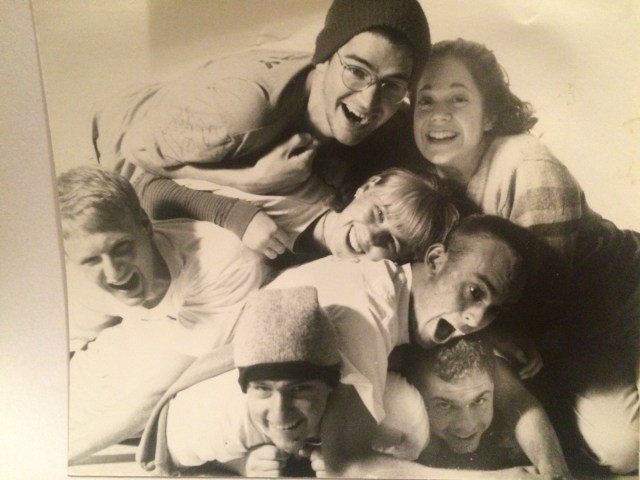
I’ll end with one of my favorite photos I developed during my darkroom days. I didn’t get an A on this project (I was still learning how to develop photos), but these are the faces and friendships that continue to help me through some of my own fears and insecurities, or what we might call “dark nights of the soul.”
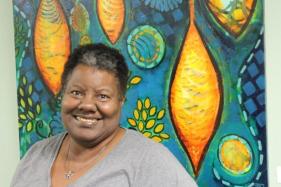
Annette Hope Billings is a Kansas poet, playwright, actress and nurse, who re-directed her method of advocating health and wellness from nursing to healing with poetry and prose.
A poet by the name of Annette Hope Billings will be at Rainbow on Sunday to help us mark the beginning of Advent. Her hope-full poetry, which she will share during the Education hour, fits nicely with the advent candle lighting ritual. (The traditional advent wreath includes four candles with the first candle symbolizing hope, the second peace, the third joy, and the fourth love.) Why not ask a poet who has HOPE as her very name to join us?
I first learned to know Annette this past summer when she led a poetry session with Freedom School scholars.
In just a couple hours she and the scholars collaborated to write the following Freedom Bumble Bee Poem (Jesse Graber illustrated it). If you’d like an enlarged view of the printed poem, click here: rainbow-freedom-honey-bumble-bee
Here is a video of Annette reading this same poem (I love the light fading in and out through the stained glass window, and how the scholars arrive toward the end.)
Many people are surprised to learn that Rainbow Boulevard, a main roadway running north-south in Rosedale of southeastern Wyandotte County, was named after the 42nd Infantry Division of the United States Army National Guard, also known as the Rainbow Division. This 42nd Division was given the name Rainbow because unlike other divisions at the time, it stretched over the whole country like a rainbow, drawing from 26 states and the District of Columbia. For the 42nd Division, the rainbow symbolized a sense of unity and common purpose.
Initially the 42nd Division adopted a half arc rainbow shoulder patch. During the latter part of WWI, Rainbow Division soldiers modified the patch. It was reduced to a quarter arc as a way to memorialize the over half of the division’s soldiers who died during the war. (If you visit the WWI Museum in Kansas City, you will see this shoulder patch of a quarter-arched Rainbow displayed.)
This history is significant to Rainbow Mennonite Church in Kansas City because in 1957, the church met in a building on Rainbow Boulevard. (Now we worship on Southwest Boulevard.) Recently I asked retired Mennonite Pastor Stan Bohn whether the Mennonite congregation knew that Rainbow Boulevard was named after a military division. The answer was yes. “The sense of our discussion,” Stan said, “was that it would be good to transition that military name to the name of a peace church.”
“I remember liking the irony,” he added.
Rainbow Mennonite, like a lot of Mennonite churches, includes veterans, conscientious objectors, and people who are active in the armed forces. Together, many of us feel ambivalent about war and about what makes for true and lasting peace. I often tell those who are interested in joining Rainbow that I’m proud to belong to a church where I hear people regularly asking, discussing, and arguing over what makes for true and lasting peace. I’m proud to be part of a faith tradition that continues to ask: Are there ways to wage peace, courageously and sacrificially, without taking up arms? And can speaking out against excessive use of force and violence be considered an act of patriotism? And finally, can we speak out against war and violence of all kinds without ostracizing or unfairly shaming veterans or those in active duty?
On a day like today, I worry that we in the peace or pacifist faith traditions too often settle into our safe, like-minded huddles and as a result, we can lose touch or lose connection with those who, for whatever reason, serve in the military or armed forces. And I worry that on days like this, Mennonites often decry proud displays of patriotism, and in so doing, lose out on opportunities to hear veterans tell their stories not only of triumph, but of anguish and trauma.
During the lunch hour today I drove to the Rosedale Arch, another nearby WWI memorial. I thought of our Rainbow veterans (current and past), family members who have served in the armed forces, and those contemplating serving now. “If only we knew the things that make for true peace,” said Jesus long ago. If only…
I want to believe, as Stan believed decades ago, that we can transition together toward greater peace and understanding, and that in so doing, we need not become separatists. Rather, we can find our place on the Boulevard, pursuing peace in our cities and world as best we can, shoulder to shoulder with people of different backgrounds and values.
In closing, here is a plug for an event happening at the National WWI Museum less than a year from now (October 19-22, 2017): Remembering Muted Voices: Conscience, Dissent, Resistance, and Civil Liberties in World War 1 Through Today. Click here for more information about this event: remembering-muted-voices2mv2171

 In preparing for this series, I looked for some kind of Mennonite-related visual or symbol to showcase. This may surprise some considering that Mennonite congregations have held widely divergent attitudes toward the use of visual symbols in worship. Obviously at Rainbow we embrace use of visual arts in worship, as you can see on this page of our website:
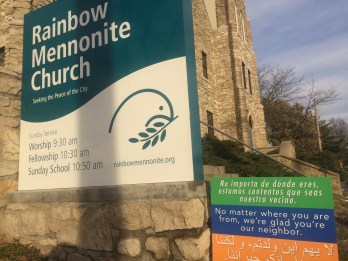 This sign has a trilingual message of neighborliness in Arabic, Spanish and English. It was designed by a Mennonite pastor in Harrisonburg, Virginia as his response to the divisive rhetoric of the primary debates. He first erected a painted wooden version outside his church.
  Speaking of hands, recently my husband and I watched a documentary about Mr. Spock, an examination of Leonard Nimoy and his portrayal of Spock in the 1960s iconic TV series Star Trek. At one point there is a discussion about the origin of the Vulcan hand greeting/blessing. By now it is well known that the idea for the hand greeting came from Nimoy’s early memories/contact with Orthodox Jews. Nimoy recalled times when the men of the congregation, known as “Kohen” (descendants of Aaron), would place their prayer shawls over their heads, raise their hands in the way made famous by the Vulcan hand greeting, and repeat the Aaronic blessing from Numbers 6. This made an impression on Nimoy, so much so that on set one day, he suggested that this hand blessing be incorporated in the TV series.
 Hebrew scholars point out that this hand gesture or blessing mirrors the Hebrew letter Shin (ש), which has three upward strokes similar to the position of the thumb and fingers in the Vulcan salute. In Judaism, the letter Shin stands for El Shaddai, meaning “Almighty (God).”



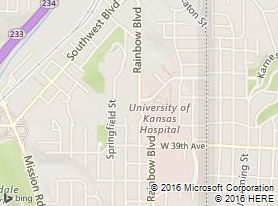 Many people are surprised to learn that Rainbow Boulevard, a main roadway running north-south in Rosedale of southeastern Wyandotte County, was named after the 42nd Infantry Division of the United States Army National Guard, also known as the Rainbow Division. This 42nd Division was given the name Rainbow because unlike other divisions at the time, it stretched over the whole country like a rainbow, drawing from 26 states and the District of Columbia. For the 42nd Division, the rainbow symbolized a sense of unity and common purpose.


 over and around the rainbow