Tossed and turned


Dear friends near and far,

Yesterday we had close to 1,600 community members lined up in and out of Rainbow Mennonite Church waiting to vote. Toward closing time at 7 pm, the remaining voters were taken to the Sanctuary where they wove in and out of the aisles. My husband and I were two of these 1,600 voters, as were some other Rainbow congregants. I was proud of the hospitality we at Rainbow offered our community. I especially loved seeing our Prayer for Peace, Act for Peace sign and the memory leaves displayed for all the voters to see. It was like we were being surrounded by the saints, our very own “cloud of witnesses” (Hebrews 12:1)


“Who are Mennonites?” I heard a voter in line ask. “I think they are the ones who help when there are storms and stuff,” said another. Others commented on how “spiffy” our church seemed.

Less than 24 hours later, I’m sensing that a lot of people, myself included, feel a little tossed and turned from political storms of all kinds. I’m not feeling very spiffy right now, and I wonder if I, or we as Mennonites, have much to offer when it comes to political storms.

I can’t and I won’t assume to know how various ones of you are feeling about the election results from yesterday. I do imagine that, however we voted, we’re all feeling drained and maybe a little sick. At the very least, we’re all feeling uncertain and all too aware of these divided states we live in.

I want to believe, as Disciples of Christ pastor Sarah Klaassen writes, that “Our faith is deep and wide and carries a wisdom that we can trust even as our trust and hope in other things is shaken.” Sarah goes on to remind us that “we have another narrative that shapes us, a story of liberation, justice, peace, risk-taking resistance against forces of separation and hopelessness….Our calling is the same as yesterday as we follow Jesus today: a calling to tune our hearts to the experiences of the most vulnerable: black lives, queer lives, latinx lives, Muslim lives, people who are poor and disabled. A calling to trust and to love even in the midst of fear.

“Some of us,” Sarah continues “have already found the resolve to hope and work. Some of us need to sit in this moment longer, in our feelings and our pain. Either way…we share a collective sigh with one another, because we are a church together, and we are not alone.”

In that spirit, I invite those of us who are feeling storm-battered to gather tonight at Rainbow for prayer. Bob Carlson will help to lead a time of prayer, singing, and candle lighting tonight in the Sanctuary from 5:30-6:00 pm. Then at 6 pm, everyone is invited to join a Prayer to Heal the Nation post-election conference call. It will feature 40 prominent interfaith leadership who will each offer a prayer for the healing of our country. This conference call is free of charge, and not just for clergy. Everyone is welcome to participate. To join, just dial (202) 478-8089. You can read more about this phone prayer conference here: https://www.eventbrite.com/e/a-prayer-to-heal-the-nation-tickets-29200181529

And then let us carry on, trusting in and enacting the narrative of liberation and peace, as best as we can.


Posted in Uncategorized | 1 Comment

Singly none

This post was originally published in November of 2016. Today I re-post it in honor of Pablo who died unexpectedly this week. Many will remember him for his jovial, mischievous spirit and for the ways he looked out for others. He volunteered many hours working to make this a safer, more beautiful Rosedale neighborhood. At Rainbow we always knew when our parking lot lights weren’t working thanks to Pablo. May he rest in peace.

The first time I wandered over to the Rainbow Community Garden across the street from the church, I heard someone yelling, “Get out of there! That’s private property.” It was Pablo, our ever-present, ever-watchful neighbor of the church. I did my best to give him a friendly wave and smile, and then introduced myself as the new Rainbow pastor. He got this unbelieving, embarrassed look on his face, put his head down, and uttered something along the lines of, “No way. I don’t believe it.” Ever since that day, every time I see Pablo he reminds me of this first encounter. And yes, he gets a kick out of telling this story every time.

img_4257This past Saturday, three years later, I once again wandered over to the Rainbow Garden. I waved to Pablo who was mowing his lawn across the street. Before long, he wandered over to see what trouble I was up to. I told him I wanted to build a Freedom School cairn. The Freedom School staff had given the church a cornerstone with a plaque on it celebrating 10 successful years of hosting this 6-week summer enrichment program. “That’s nice,” Pablo said. And before I knew it, he began helping me carry and stack rocks, one by one. We talked about this and that, including his family and religious upbringing. He asked how Rachel, our former Community Services Coordinator, was doing, and he pointed to Aaron Barnhart and Diane Eickhoff who were digging up sweet potatoes and said, “They are some hard workers!” And then, as we held and placed each rock, designed and gifted to us by the over 100 Freedom School scholars and staff, Pablo said, “That school…Freedom school… is pretty neat. It makes a difference.”

I set out to build a cairn, a gathering of stones often used to mark trails, sacred or remarkable places, and in the process something was stirred in me. I found myself feeling profoundly grateful for this opportunity to work alongside people who are seeking to make a positive difference. What started out as a straightforward Saturday morning project, turned into an act of prayer as I gave thanks for the opportunities God gives us in each time and place to make a positive difference. And I said a prayer of thanksgiving for Pablo, whose almost daily smile, wave, and jokes makes this a more interesting place.

For the rest of the day I found myself humming the tune Pete Seeger helped popularize:

Step by step the longest march can be won, can be won
Many stones can form an arch, singly none, singly none

img_4256

Posted in Uncategorized | 1 Comment

Walking through fire and getting burned

fullsizerender-23-1

The Burning Bush at Rainbow. Photo taken by Lonnie Buerge.

“But now thus says the Lord, he who created you, O Jacob, he who formed you, O Israel:

Do not fear, for I have redeemed you; I have called you by name, you are mine. When you pass through the waters, I will be with you;

And through the rivers, they shall not overwhelm you;

When you walk through fire you shall not be burned, and the flame shall not consume you.

-Isaiah 43:1-2


This Sunday, Rainbow congregant Amy Kliewer will reflect on turning points in the wilderness—times when she walked through metaphorical fires, and felt a little charred as a result.

Visiting with Amy has led me to reflect on fires that threaten to consume us—whether those fires be related to illness, job loss, conflict, trauma, oppression, violence, or all of the above. It is said in Romans chapter 8 “that all things work together for good for those who love God,” and that nothing will be able to separate us from the love of God in Christ Jesus our Lord. But for those experiencing or recovering from consuming flames, for those drowning in the rivers, gasping for breath, these promises can sometimes sound too good to be true. And there is nothing that burns like a broken promise.

Sure, I hear stories of those who walk through these so called fires of life, and come out more resilient and stronger than ever. I’ve seen people rise from the ashes of grief and pain, shining with an unbelievable light. But that doesn’t mean they don’t carry scars. None of us are without scars.

So I’ll end this post by inviting us all to reflect on some of these questions, questions that I believe reside in the story of Moses and the Burning Bush (Exodus chapter 3).

  • What are your significant life turning points—times when you sensed the presence or absence of God in new or more profound ways?
  • Are there moments or seasons when you have felt the metaphorical fires of life, but weren’t consumed? What helped you through those moments/seasons?
  • What threatens to consume or overwhelm you today?

And more broadly:

  • How are we collectively turning with God toward those who are being consumed by forces of hatred, greed, racism, sexism, and oppression of all kinds?
  • What might God be calling us to turn away from in order to join in the work of seeking greater justice and compassion?


Posted in Uncategorized | Leave a comment

Psalm 23 for the 21st century

img_3972

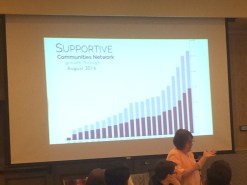
The Supportive Communities Network (SCN) is growing! I’m proud that Rainbow was among the few congregations at the far left of the graph who joined SCN in the 90s.

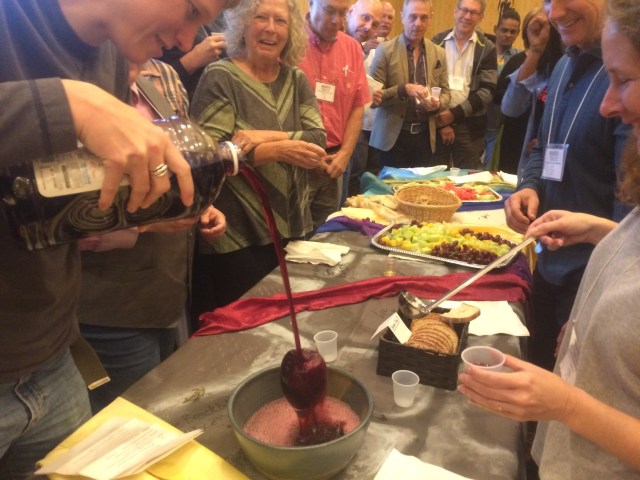
This past weekend I was honored to attend the 40th Anniversary celebration of the Brethren Mennonite Council for Lesbian, Bay, Bisexual and Transgender Interests, also known as BMC. Rainbow has been connected with BMC since 1990.

During BMC’s Sunday morning worship, preacher Regina Shands-Stoltzfus offered some Psalm 23 reflections. She shared how so many of the psalms give voice to our experiences of orientation and disorientation, abundance and scarcity, hope and pain, justice and injustice. “Though I walk through the valley of the shadow of death,” Regina repeated, “though I walk through the valley of the shadow, though I walk through the valley, though I walk through, though I walk….I walk…..I….walk.”

We continue to walk through and in shadows, we continue to face enemies and oppressive forces, and while we don’t always arrive, we search nonetheless for those rainbow-colored pastures, overflowing cups, still waters, and fabulously-set tables, trusting or at least hoping that we are not alone in this search.

img_3969

In preparation for BMC’s celebratory weekend, my good friend and Mennonite colleague Joanna Harader and I collaborated to write our own BMC-style Psalm 23 (see below). To say we collaborated might be a stretch; I was more the cheerleader for the fabulous, unicorn-chasing Joanna.

The Holy One is our shepherd, we have enough:

enough love and longing

enough community and compassion

enough sacred and sassy

enough fierceness and fabulousness

They make us lie down in green pastures and lead us beside still waters and restore our souls:

at BMC gatherings

at Connecting Families

at Pink Menno rooms

at this place, right here, right now.

You lead and accompany [us] / into the path of justice and solidarity, / and [we] find integrity in your way.[1]

the way of speaking out and listening well

the way of deep love and deep pain

the way of celebration and protest

the way of dancing and wall-demolition

Even though we walk through the valley of the shadow of death

where we are talked about, but not to

where our giftedness is not received

where our relationships are not honored

where we are labeled and cast aside

We will fear no evil, for you are with us; your rod and your staff, they comfort us.

We lean on your Word that speaks love and justice

We lean on your people, who speak acceptance and life

We lean on your church where it is open, affirming, and welcoming of our whole selves

We lean on your Spirit of praise, protection, and protest

You prepare a table before us

this table made from fallen walls

this table covered with all the colors of the rainbow

this table of fountains and fruits and abundance

this table where we are welcome

In the presence of our enemies . . .

people and principalities

polities, procedures, and processes

“dialog” and “discernment”

resolutions and yet another task force

You anoint our heads with oil

the oil of blessing

for lives that are holy and whole, sacred and fabulous

the oil of commissioning

that we might go forth in our fierceness to tear down walls and set spectacular tables

Our cups overflow

our joy overflows

our hearts overflow

our queer and queer-loving selves overflow

with the abundance you pour out

Surely rainbows and unicorns will follow us all the days of our lives

and we will dwell in the fabulous house of the Divine forever.

[1]    From Murphy Davis

Here are some more reflections and photos from BMC’s 40th anniversary weekend:

“Walls to Tables”: A BMC Gathering

Walls to Tables: A BMC Retrospective & Family Reunion

Last but not least,  we at Rainbow have been busy writing and publishing our own Psalm 23 adaptations. Copies of these Psalm 23 magazines are now available for a $10 donation.

Posted in Uncategorized | 1 Comment

Rainbow Mennonite Catholics (RMC)

During this week when Catholics around the world are celebrating the Feast of St Francis of Assisi, I find myself thinking about Mennonite Catholic relations. This is a subject matter near and dear to my heart especially since my extended family is made up of both Mennonites and Catholics. Here is a picture of my Mennonite dad and Catholic uncle-in-law standing at a corner in Rome.

img_0691
At least 12 people closely connected with Rainbow were raised Catholic, and while this isn’t the case for everyone, many of them still strongly identify as Catholic. Rainbow is actually full of many bi-ecclesial families or marriages (spouses or family members with different religious upbringings).

This is what prompted me to host a Rainbow Mennonite Catholic conversation last Sunday evening. Five Mennonite Catholic couples came and shared what they appreciate about the faith tradition and upbringing of their partner, as well as what troubles or mystifies them. I have a feeling this will be the first of many bi-ecclesial gatherings and conversations at Rainbow.

While this might not be the case in Mennonite circles today, Mennonites have long harbored suspicion toward the Catholic church. Some Mennonites have been falsely taught that not only are Catholics not Christian, they are historical persecutors led by the anti-Christ. As Mennonite pastor Joetta Schlabach reminds us, “Anabaptism had its beginnings as a movement that broke away from the Magisterial or the Catholic Church because of what they perceived as the church’s inconsistencies and practices that weren’t based in biblical understanding.”

As a  result of that persecution, says Joetta, Mennonites have had the tendency to isolate and self-protect, staying away from other Christians, especially those who had different views on war and personal living. In many Mennonite traditions, great emphasis was placed on the church being set apart, pure, holy, “without spot or wrinkle” (Ephesians 5:27). We’ve now had 500 years of nurturing those tendencies of separation and suspicion, says Joetta. This doesn’t give Mennonites a great track record in terms of ecumenical dialogue and cooperation.  (You can view a 30 minute video of Joetta talking about Mennonite Catholic relations here: Mennonite Catholic relations )

Joetta and her Catholic husband Gerald belong to a Mennonite Catholic movement called Bridgefolk. Gerald is actually one of the founders of this movement which is described as follows on the Bridgefolk website:

Bridge folk is a movement of sacramentally-minded Mennonites and peace-minded Roman Catholics who come together to celebrate each other’s traditions, explore each other’s practices, and honor each other’s contribution to the mission of Christ’s Church. Together we seek better ways to embody a commitment to both traditions. We seek to make Anabaptist-Mennonite practices of discipleship, peaceableness, and lay participation more accessible to Roman Catholics, and to bring the spiritual, liturgical, and sacramental practices of the Catholic tradition to Anabaptists.

One of these days I hope to attend a Bridgefolk gathering. I also hope to travel in Rome some day! Until then, I hope we can keep learning from one another, building bridges across religious difference.

If you are interested in learning more from those who identify as or work within Mennonite Catholic circles, here are two more links:

Mennonite Catholics and Catholic Mennonites: Bridging, not Splitting, the Difference

Tribute to Ivan Kauffman, co-founder of Bridgefolk (Ivan was cousin to long-time Rainbow member Ralph Kauffman)


Posted in Uncategorized | Leave a comment

Green with pride

Every time I take people on a Rainbow church tour, I make sure to take a loop around the outside of the building in order to point out Whitmore Park, the Mennonite Voluntary Service house up the street from the church, the bus stop/pocket park, the Rainbow Community Garden, the Rainbow Remembrance Garden, and the empty lots owned by the church.

greenspaces

Recently during one of these tours someone asked if all of this land and property felt more like a blessing or a curse. “With property comes great opportunity….and added responsibility and risk,” he said. Yes, indeed.

Rainbow congregant Aaron Barnhart asked a similar question years ago during a congregational meeting. Do we, he wondered, see our outdoor spaces as primarily maintenance or ministry, or both? Aaron is someone who spends just as much (or more) time walking and tilling the Rainbow garden as he does inside the building. He knows our church neighbors to the west of the church better than anyone, except maybe our regular Whitmore Park stewards.

To quote Aaron: “Rainbow’s green spaces (Park, Gardens, empty lots, etc.) are physical extensions into our community that we serve, many of whose members will never permeate the walls and hear our beautiful organ and see our lovely stained glass from the inside. This is our outreach to our community. And up until this point we have thought about it as a maintenance issue, done by committees. Maintenance is an important aspect, but it seems to me that there is an opportunity to think about green spaces not as singular units, but as a unitary whole.” Our outdoor spaces, Aaron reminded us, “are where we reach out and present our values to our neighbors.” These values, again according to Aaron, include providing a safe place for people to play, emphasizing nutrition and making sure people have access to healthy options, and telling our neighbors we love them by giving them a chance to rest their feet while waiting for a bus we advocated for.

This coming weekend during our Rainbow church retreat, attendees will reflect on the ministry and maintenance needs, risks, and opportunities related to these outdoor spaces surrounding the church building. We will consider the question: What values are we currently imparting to our neighbors via these green spaces? And are there new things we could try that would impart new or different meaning to these outdoor spaces? This is not a decision-making meeting, but rather a chance to reflect on the gifts and challenges that come with stewarding green spaces as a faith community.

Whether or not you can make it to the retreat, I hope we will all give these questions some thought in the weeks and months ahead.


Posted in Uncategorized | 1 Comment

What if the children are listening?

burning-bush

Burning Bush drawn by Marina Kaufman

Genocide. Babies floating in rivers. Murder. A burning bush. Horrific plagues. As we begin our Fall worship series on Exodus 1-3 , I find myself wondering: What if children are actually listening to these stories? And assuming they are listening, what are they hearing and comprehending? And are we prepared to listen to their questions and responses?

Fortunately at Rainbow we have what is called WorshipArts, an opportunity every Sunday for K-5th grade students to ask questions and respond to what they heard, felt, and sensed during Sunday morning worship. It’s a 10-15 minute reflective pause  or bridge between worship and Sunday school.

This past Sunday WorshipArts participants talked about the names in Exodus 1-2 as well as their own names. Here is Rosi Penner Kaufman’s description of WorshipArts time this past Sunday:

Terri did a remarkable job in WorshipArts getting the kids to think about names, their own names, what their names mean… When Terri asked what was different in the sanctuary today, I expected that the bush would be the first thing mentioned. Actually, someone said they saw the organ move, and we finally understood that they had never noticed the swell shutters move. I promised to play something next week that would make the organ move a lot.

Terri Gaeddert also wrote a description from Sunday which you can find on the new WorshipArts blog. Click here: http://rainbowmennonite.org/whats-in-a-name/

Here is one more indication that young congregants at Rainbow are paying attention. A woman named Nancy emailed this note after the service on Sunday regarding her two grandchildren: “Both of them were busy with their children’s bulletins and crayons during your sermon, and I assumed they weren’t tuned in. But, when you talked about ordinary women doing extraordinary things, Owen whispered to me, “like you!”  Whew!”

I have long thought that instead of isolating children on Sunday mornings, it’s best to invite children into the very center of communal life, worship, and work, encouraging their active participation as they are able. This isn’t always possible, but it remains a worthy aim. And so with that in mind I invite all of us, whether we have little ones in our direct care or not, to reflect on the following questions and ideas:

How might we continue introducing young congregants to the worship space at Rainbow? What opportunities exist to point out and discuss various symbols, windows, colors, or visuals? Be ready to ask little ones what they notice. For example, recently a young boy named Alex invited me to go on a Rainbow tour with him as the tour guide. “It’s your turn to follow,” he said. It was probably the most entertaining church tour I’ve ever been on. The beautiful thing was watching him point out things that he noticed and that he found interesting.

I know one dad who brings colorful index cards to church for his young son to hold under each hymn line so that his son has something active to do during hymn singing.  I’ve heard other parents say that sometimes letting children hold the hymnal or turn the pages can encourage greater involvement. What are other creative ways to help children follow along with singing or other aspects of the service?

I recognize that these questions/ideas assume that adults have the energy and attention for this level of engagement with little ones. This isn’t always the case, especially for already worn-out parents. Taking children to the nursery will always remain an option, especially for the littlest ones.  And quite frankly, sometimes I wish we had an adult nursery or cry room for adults who need a quiet, set apart place to sit on Sunday mornings. Some days sitting alone in a cry room would sure beat having to wrestle with some of the Rated R stories in the Bible! Maybe it’s time we start an Adult WorshipArts option because whether you consider yourself young or old, we could all use some reflective pauses as we unpack what we are hearing and sensing on a given Sunday morning.

In case you missed it, or in case you were too distracted on Sunday to hear, I’ll include a link to my sermon from Sunday called “Meeting Moses again for the first time.”  meeting-moses-again-for-the-first-time

You can also get the audio by clicking here: http://rainbowmennonite.org/media/

Oh and do yourself a favor: Ask Alex for a church tour.


Posted in Uncategorized | Leave a comment

Just keep singing

What follows is a guest blog entry by Music Ministries Director Rosi Penner Kaufman:

c2d2a9_e2edeb46d26346538f24ef1f69977c09

Every passion has a convention. Within our family, in the last year someone has been to Naka-Kon (Japanese anime convention), EquiFest (everything horse), and Trombonifide. Last July, I had my chance: I was fortunate to spend four days at the Hymn Society conference at the University of Redlands. Imagine, four days of hymn singing! Enthusiastic, deeply-moving hymn singing. It was a gathering of music leaders, hymn text writers, composers, pastors of word and music, and people who love to sing. I came away renewed, enthused and stretched.

For several decades I’ve heard folks express the fear that that congregational singing is on its way out, being replaced by performance-centered praise bands and “off-the-wall” music. Not the case for these folks. In fact, from what I’m reading and hearing from colleagues, there is a resurgence of congregational singing as people look for authentic ways to participate in worship. New texts are being written that reflect and encourage a faithful response to current culture. There are new tunes being written, both for four-part and unison singing. Not all of this new music will endure, but the fact that there is so much creativity being poured into this genre is encouraging. And there are new hymnals being published, included a new Mennonite hymnal just under way with hopes that it will be published by 2020.

There were many moving moments, but the most memorable event for me was a hymn festival that combined video and singing, “Moving pictures, everlasting song.” The leaders interspersed video excerpts that gave context to songs that brought people together in crisis:  the non-violent overthrow of communism in Estonia, the resilience of the Jewish orchestras in Nazi concentration camps, the march and protest songs of the Civil Rights movement, the songs of the migrant workers, anti-Apartheid protest songs, and Native American songs. In each case, there was a common song or repertoire that brought people together. Singing provided something larger than the individuals, a common experience. The question the leaders left us with is, “Given our diverse culture, even within the church, how do we build a common repertoire?” In all of those situations, there was something recognizable that brought people together.  President Obama can spontaneously launch into Amazing Grace and we all know it, but in crisis, in protest, what do we sing? In family, church, or wherever we gather, we need to keep singing.

All this leads me to what is perhaps the most enthused I’ve been for the beginning of a choir season since, well, last September. I’m always enthused about the beginning of choir rehearsals, but this year I believe I come with even more resources and ideas for ways the choir can participate in worship services and build our repertoire as a congregation. That’s what we do – the Rainbow Choir isn’t a performing group; I consider the choir part of the worship leadership. Yes, we usually sing an anthem, but I think just as important is the contribution the choir makes to enlivening the hymn singing of the congregation. I believe music can inspire and respond to the spoken word in worship, and that choral singing allows an expression that is unique.

New voices are always welcome. Our routine is that we practice from 6:45 until 8:00 on Wednesday evenings. For those who want to gather early, we have a light supper from 6:15-6:45 for a $5 donation. We sing most every Sunday from the end of September through the end of April. We don’t take attendance, but the more the merrier (and the more fun it is).

Our first rehearsal will be a little different – see the newsnotes for directions and information about our September 7 rehearsal. And between now and then, just keep singing.

Rosi

Posted in Uncategorized | Leave a comment

Ted’s Talk

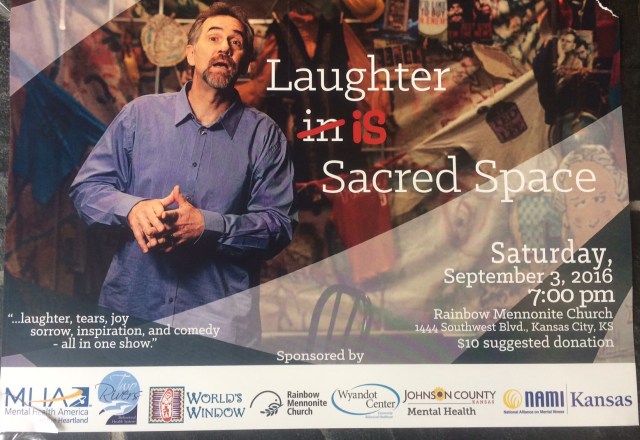
“Is this guy funny?” asked one of our Rainbow neighbors as she pointed to this sign on our church door. Before I had a chance to respond, she answered her own question: “Most church people aren’t very funny, you know.”

FullSizeRender (11)

I didn’t know how to respond, especially since one of the topics Ted will grapple with this weekend is suicide, namely the death by suicide of his acting and creative partner for close to 20 years, Lee Eshleman.

This is hardly something to laugh about. And yet knowing Ted, I anticipate that we will laugh together this weekend, cry, cringe, and maybe (hopefully) grapple with new and old questions.

I remember watching Ted of Ted and Lee when I was a little girl growing up in Hillsboro, KS. They were the goofiest and most irreverent Mennonites I knew. They flailed across sanctuaries, stages, and biblical stories in a risky and silly manner, and I loved it. They gave audiences and little girls like me permission to see and appreciate the absurd in life, in faith, in community, and yes, even in the Bible.

I therefore look forward to Ted’s talk, both on Saturday night and during Sunday morning worship.

I also look forward to giving Ted a hard time about the mark he left in my home town of Hillsboro in 1995. And when I say mark, I mean an eight-foot-long crack in a wall that Ted is responsible for as a result of his stage shenanigans.  It’s been patched since then, but the crack is still there. Thanks to my mom, I have pictures to prove it.


Such is life. The cracks, the losses, the grief that make up our lives, are still here. And fortunately artists like Ted are here to help us grapple with it all—the absurd and the beautiful.

Click the following link for more information about Saturday’s performance:Laughter-Human-Faces-Tour-PR

And here is a link to a recent article about Ted published in The Mennonite: https://themennonite.org/seven-questions-ted-swartz/

Posted in Uncategorized | Leave a comment

Tree-ific!

The first day of summer brought with it a near tree catastrophe in our backyard. Fortunately for us and our neighbors, no permanent damage was done. What does last from that experience, other than a bunch of big logs we don’t know what to do with, is new appreciation for and curiosity about trees.  (This appreciation for trees was only made stronger while listening to Radio Lab’s recent episode on trees.)

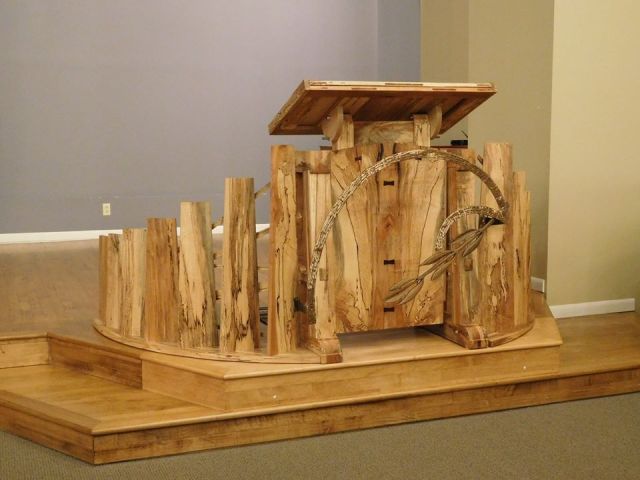
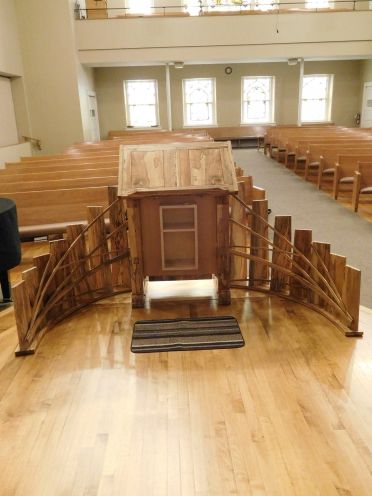
I am therefore going to preach a tree-ific sermon this Sunday at Rainbow. And as I prepare, I find myself thinking about another special tree that once stood on the west side of the church. Now the wood from that tree stands in front of the Rainbow Sanctuary as our pulpit.

Here is that story as told by Sculptor Matt Kirby (pictured below in our church shed attic) from Lawrence, KS:


“The spalted maple used in the piece was harvested some years ago from a tree standing on the church property. The silver maple had been planted shortly after WWI as a memorial to a fallen soldier from the Methodist congregation which had been the previous owner of the building.

FullSizeRender(1)

The wood (spalted maple) was a treasure. Spalted means that the tree was in the early
stages of decay. Spalted means there was mold growing in the wood-grain which
produces acidic acid. The wood represents free flowing natural patterns. It’s both chaotic and beautiful. Nature in its productive rage is lovely.

matt pic1

The pulpit is designed so that the speaker has an experience of being in a small grove, basket, or boat, with a sense of contained visibility; that the place of speaking has a sense of holistic purpose about it, somewhat in solitude but presented to the community. The idea was derived partly from “Dendritaes,” ascetics in the early Christian church who would stand on columns for long  periods as demonstration of forebearance to faith. The term means literally “Tree People”. The flanking elements are meant to represent people gathering around a table, a common place of nourishment.

12764371_1687334151544865_5969196598651637843_o


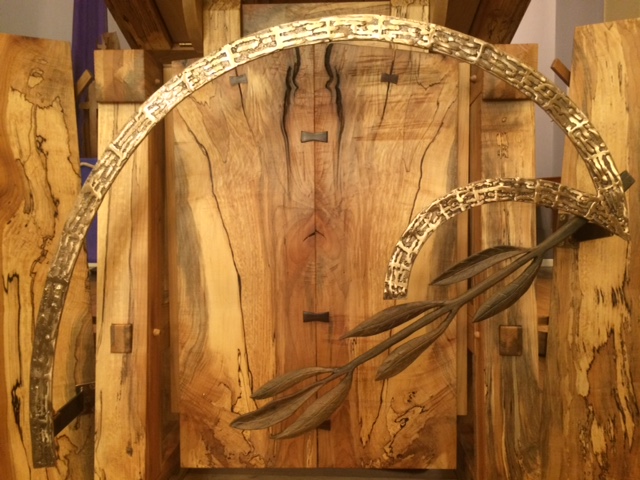
The easel surface slides down to a seated reading level for handicap access. Close up of the center panel, inspired by the work of George Nakashima,with grain chosen and structured for an analogue to ideas of exultance, rising, and emanating forth. The top panels on the easel were chosen with similar intention.The entire easel assembly rides up and down on columns supported on calibrated springs for a neutral weight function. Tilt, height and table slide are fastened by bronze dowels.

In addition to the spalted maple, fabricated bronze and lignum vitae are used in a representation of a peace dove which appears to hover in front of the pulpit. Seven (leaves) is an irresolvable number, this perfect number that can never be fully
known. It’s infinite. Lignum Vitae in Latin means “Tree of Life.” Lignum is that lig in religion. The fiber, the thing that binds us together. The Lignum Vitae will turn green over time as it oxidizes.

IMG_1188

Though the entire piece has lots of glue in it, used to laminate the timber stock for maximum grain figure and interest, the actual joinery is all dry, and pegged to fasten, much like a traditonal timber frame barn. The trunions, easel, support columns and top surface all knock apart from tight, slightly compressed fit, and the top spandrel between the columns is tenon-fitted to almost air-tight dry mortises (which produce a satisfying “pop” when pulled apart!) in order to unify their mechanical function, but eliminate binding due to seasonal expansion.

IMG_20150620_132856327

The first sermon spoken from this new pulpit was by the church’s first pastor Stan Bohn from North Newton, KS who gave some reflections of his work in the Civil Rights Movement, and in particular, leading (with enormous grace and wisdom) an integrated group of young people through various instances of segregation.”

Final reflections from Matt Kirby:

How do you know what’s going to be inside of a tree? It has this sense of discovery
about. There’s what the sawyer discovers when opening the tree, there’s what the
woodworker discovers moment to moment.

When I was building this, I was seeing things moment to moment and reacting to things moment to moment. The whole project was a pre-planned improvisation. That’s what I think makes it an artistic expression. The circumstances of its creating can change in response just like the tree grew in response to changes in weather.

Isn’t this tree-ific?!


Posted in Uncategorized | Leave a comment