I didn’t start the fire!

The last time I went through a pastoral evaluation, the fire trucks were called. I was minding my own business in the church hallway, after being asked to leave the congregational meeting momentarily, when I started to smell smoke. I consulted with others before determining that yes, we had better call 911.

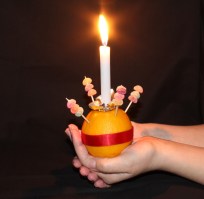
“I promise I didn’t start the fire, ” I kept saying to people as we vacated the church. And this was true. Someone had been in our small chapel burning incense without us knowing it. Fortunately no damage was done and nobody complained too much about the shortened meeting. Still, people gave me a hard(er) time. That’s because I had already developed a reputation at this particular church for some misguided choices resulting in a smoky Christingle-websanctuary on Christmas Eve. (The thought of candles made out of oranges sounded like a good idea at the time.)  Still to this day people at that church will ask me if I’ve started any fires recently.

I usually laugh it off but still, I will forever associate pastoral evaluations with loud sirens and big, strong people in big fire protected suits and masks walking around the church building assessing the damage.

If my memory is right, this fire incident occurred around Pentecost, a time when we read of “divided tongues, as of fire.” (Read Acts 2).

I tell this story/confession because 1) Pentecost is this coming Sunday and 2)My first three-year pastoral evaluation at Rainbow begins this coming Sunday. I hope to the good Lord that we will not need the assistance of big people in big suits and masks. We will be joined by a consultant from Western District Conference, but I doubt he will bring fire gear.

One never knows what will happen on Pentecost, so come prepared for surprises. And please, come prepared to stay for the brief congregational meeting after Sunday School.

And finally, I’d love someone to sing this Billy Joel/ Pentecost inspired song someday at Rainbow. (I’d do it if it wasn’t for being evaluated right now.) I commissioned my good friend and fellow Mennonite pastor Joanna Harader to write it last year:

Hit us with tongues of fire—with the wind that’s moving and the Spirit grooving.
Hit us with tongues of fire—let your love enflame us and your power claim us

Upper room, Pentecost, resurrection beat the cross.
Violent wind, Spirit kin in Jerusalem.

Gallileans, Cyrenes, Phrygians and those from Crete.
Elamites, Parthians, visitors from Rome.

Arabian and Egyptian. Too much wine. Too much din.
Prophecy, destiny, dreamers dreaming dreams.

Signs in heaven, signs below, blood, fire, smoke billows.
Darkened sun, promised One, Messiah Jesus Christ.

Hit us with tongues of fire—with the wind that’s moving and the Spirit grooving.
Hit us with tongues of fire—let your love enflame us and your power claim us.


Posted in Uncategorized | Leave a comment

Reaching out, in, through, and toward

Why be connected to our neighbors and engage in community ministry?
What do we hope our impact will be?
What needs face the Rosedale neighborhood where Rainbow Mennonite is situated?
What will Sharing Community Rosedale, Inc. be like in 5-10 years?
What are our passions and interests—what would we like to see happen in this community?
How might we recruit more volunteers?
Where and how are we willing to engage as a church?


These are just a few of the questions that we at Rainbow will be wrestling with this weekend during extended church-wide conversations about the who, what, where, how, why, and when of community outreach. We will be joined by Consultant Joy Skjegstad, author of Starting a nonprofit at your church and Winning Grants to Strengthen Your Ministry. 

When I think about outreach and community ministry, my mind goes to a National Public Radio Humankind interview that featured reflections from Rev. Kristin Stoneking. Kristin is the Executive Director of the Fellowship of Reconciliation, an interfaith pacifist organization founded just prior to WW1. Kristin grew  up in the house (now a Mennonite Voluntary Service house) down the street from Rainbow. Her father John Stoneking was then serving as the United Methodist pastor. John was one of many Methodists instrumental in welcoming the Mennonite congregation (now Rainbow Mennonite) to worship in the Methodist building starting in 1969. Click here to read more about our history.

During her interview with Humankind’s host David Freudberg, Kristin said that she came to non-violence organically. She credits her parents for exhibiting the three dimensions of Gandhian nonviolence: personal transformation, spiritual transformation, constructive program, and political action. She also credits the Mennonite congregation. Here is what she said:

Both of my parents were religious in the sense that we were a part of a religious community. And the Mennonites in my early life, as a historic peace church…with persons who really valued being a peacemaker and held up practices of peace as serious business, really influenced me.

I saw my own parents embracing spirituality, but also working very hard at creating programs that lifted people up, that lifted up choices towards life. One of my earliest experiences was of living in the inner city of Kansas City and our  congregation was across the street from a school that the KC school board decided to close and the decision was to sell the property to a company that was going to bury old oil drums on the site and knock down the school, knock down the playground, the only playground for miles.

And my dad and our congregation took on the school board. And through lots of political machinations and attempts to get this congregation to go away, they won. They won the site for the people of the neighborhood and built a playground there. They did so through organizing, they did so through different kinds of resistance and campaigns.

That is classic non-violence in action. But I never heard that term. It was sourced from the community that held each other up spiritually. So what I saw demonstrated was that in order to take on violent systems or violence in the world, it’s really important to have community of accountability and support to remind you what you believe in and where you come from.

You can find the full interview here: http://www.humanmedia.org/nonviolence/tabs.php?t=6 Kristin is interviewed at about minute 7:00 on segment 2.

I love that line: “It was sourced from the community that held each other up spiritually.”

I hope that the conversations we begin this weekend will inspire, challenge, and motivate us to be this community of accountability and support, holding each other up spiritually as we reach out and reach in, hopefully always reaching toward one another as we seek a more peaceful and more just neighborhood and world.

Our conversation on Friday will begin at 6 pm.

Posted in Uncategorized | Leave a comment

Earth prayers

Last Sunday a group from Rainbow poured prayers into the church compost pile. It’s something we have done the last couple of years near Earth Day on April 22.

It might seem a little crass to compost prayers. And yet as I moved my hands in the wet, leafy compost and as I smelled the sweet aroma, and as we covered the little slips of paper with this nutrient-rich humus, all I could think about was how prayer so often roots us in this good earth. Prayers grow us as we seek to grow life around us, often producing fruit we can’t always imagine.

In an article called “Fruit of the Vine,” Mennonite Pastor Isaac Villegas suggests that we in the church would do well to spend more time in the compost—  “the manure, the waste pile, the places where we’ve thrown rotten fruit, unwanted gifts.”

He continues:

The church needs people who become familiar with the manure, who dig into our smelly and mucky compost—the storehouse of gifts from the past, and discarded fruit in the present, the unwanted and forgotten and dismissed…We have to open our eyes to the beauty of God’s work in the places we’d rather not step with our clean, white shoes, without spot or wrinkle…Left to ourselves, we’d rather not get our hands dirty. We’d rather live without our compost—make it go way, export it to far off places, out of sight, out of mind. But if we do that, we lose the rich soil that can grow us into resurrected life.

Compost, Isaac says, is one of those places “where we can begin to see the seeds of resurrection.”

And so, our congregational prayers offered anonymously on little slips of paper and put in a prayer bowl, are now soaking in nutrient-rich humus. (Either that or some squirrel has run off with a prayer or two, hopefully communing with God in ways only squirrels can.) And as our Rainbow Garden starts to show life again, thanks to the compost we feed it, so may new, resurrected life grow in us.

IMG_4061


Posted in Uncategorized | 1 Comment

In search of tablelands

When I was in Palestine/Israel I watched many a young shepherd weave around the hilly  and treacherous countryside, leading their flock to clean water. Armed Israeli guards stood at a distance, keeping a close eyes on these young Palestinian boys as they cared for their flock.


I thought of a story I read many years ago. It takes place during the Palestinian uprising in the 1980s. The Israeli army decided to punish a village near Bethlehem for not paying its taxes which the village claimed, simple financed the occupation.  The officer in command rounded up all of the village animals and placed them in a large barbed-wire pen.  Later in the week a soldier was approached by a woman who begged him to release her flock, arguing that since her husband was dead, the animals were her only source of livelihood.  The solider pointed to the pen containing hundreds of animals laughed and said that even if he wanted to help, it would be impossible because he could not find her animals.  She asked that if she could in fact separate them herself, would he be willing to let her take them?  He agreed.  The soldier opened the gate and the woman’s son produced a small reed flute. He played a simple tune again and again, and soon sheep heads began popping up across the pen.  The young boy continued his music and walked home, followed by his flock of 25 sheep.

The Palestine boys I saw did not have  reed flutes, but I could tell that they had an unbreakable and affectionate relationship with their flock. Psalm 23 came to mind as I watched them guide their sheep to the water, especially the lines, “You prepare a table before me in the presence of my enemies.” This line often gives me pause. I can’t say I completely understand what it means or suggests. Are we eating at this table, and are enemies invited to the table or are they simply present, lurking in the shadows? Or is the psalmist suggesting that despite the enemies, despite the violence and hatred that surrounds our living, a safe place, a gathering place is being prepared. Clean water is being prepared. Peace is being prepared. We need not fear. Instead, we are invited to strain our ears to listen for the way toward safety, the way home.

In a book called A Shepherd’s look at Psalm 23 author Phillip Keller, an East African shepherd, writes vividly about this table. He says that as a shepherd once a year he would lead his flock to the high mountain country of the summer ranges. These are known as tablelands, an area of land much sought after by shepherds. These high flat topped platauxs are referred to as mesas, the Spanish word for tables.

Often these tablelands  are remote and hard to reach, and so the energetic and aggressive sheep owner must take the time and trouble to ready these plateaus for the arrival of sheep. Early in the season, he writes, before the snow has been melted by spring sunshine, the shepherd goes ahead and makes preliminary survey trips into this rough, wild country. It’s looked over with great care, keeping ever in mind its best use for his flock during the coming season.  Watering holes need to be cleared and cleaned from the accumulated debris of leaves, twigs, stones and soil which may have fallen into the water source during the autumn or winter. A supply of salt and minerals is distributed over the range at strategic spots for the benefit of the sheep. The shepherd must check for poisonous weeds. Furthermore, a shepherd must also keep an eye out for predators-signs of wolves, coyotes, and the like. Only the alertness of the shepherd who tends her flock on the tableland in full view of possible enemies can prevent them from falling prey to attack.

You prepare a table before me in the presence of my enemies….

We can probably all think of tablelands that make up our life-those safe landings, those shepherds and flocks or communities who provided for us when we were in need. Many, many people are searching for tablelands. If not clean water, a safe place to learn, grow, and be fully themselves, safe or safer from harm.

Implicit in Psalm 23 is that God our Good Shepherd, or for Christians, Jesus as the Good Shepherd goes ahead of us preparing these tablelands. And as those who seek to follow this Jesus perhaps we will have the strength to do the same. Perhaps we will be among those who remain alert, who seek and prepare and create  tablelands of our own-safe landings for ourselves and those in need.

On Monday of this week I had a younger cousin stay with us. I brought her here to Rainbow to show her around. It was late evening and as we pulled up. There were about 15 or so people in Whitmore park, and there were interviews taking place for our Freedom School program this summer. Psalm 23 was running through my head as I walked her around the building and grounds. Later she asked me what I was going to preach on Sunday and I mentioned this idea of creating or searching for tablelands. We then wondered together if programs like Freedom school or places like the playground were city tablelands of sorts- safes places for children and adults to play, discover, learn, and reflect together.

I invite us to keep this image of a tableland in mind as we now consider two more Psalm 23 adaptations written this week by Linda Shelly and Gail Goeke. Linda is a Court Appointed Special Advocate volunteer who works to provide a safe and permanent home for children in need. Gail recently traveled to TX and provided pro bono legal assistance serving women with children detained in the largest immigrant family detention center in the United States. She considers Psalm 23 from the perspective of a detained woman/mother.

Psalm 23 at the Courthouse by Linda Shelly
The Lord is my shepherd.
He is everyone’s shepherd.
None of us shall be in want.
He reminds me to rely on Him when my heart and those around me, is breaking.
He is right beside and amongst ALL of us.
He will quiet our heads, our hurts, and our hearts.
He does restore our souls to wholeness.
He shows us the path and is willing to redirect us many, many times when we falter.
All of this done in and for His name.
Even though we walk through many messes caused by our own bad choices,
We need not fear evil, for God walks with us and through us.
God’s words and His mercy can and will comfort all of us.
At times one of us has her heart broken apart on the witness stand while others of us
throw words of shame and blame at  her.
God is there – with the one being shamed and those doing the shaming.
God pours his love through all of us in our actions to each other;
in our remembering of, “That could be me on that witness stand.”
My heart overflows.
Surely goodness and mercy will be shown to all of God’s children –
those too young to use their voice
and those whose voice is drowned out by shame and guilt.
And we will ALL dwell in the House of the Lord forever.
And on the days we feel too broken to feel this, this message will be brought to us –
even if only through a squeeze of a hand, a Kleenex offered, and a tear shed out of grace;
Grace for each of us.
Amen.


 Psalm 23 adaptation by Gail Goeke

God, you are my soul’s welcoming lamp, my light in the window.
Your house of rest, solace, and hope beckons.
I shall not despair.
You guide me through the nights of humiliation and desperation,
still haunting my dreams.
You deliver me from the powerful who have no respect for life.
I will no longer submit to their evil demands.
You give me courage to speak.
You give me strength to protect my child.
Feed my children.
Release my shackle.
Gather my loved ones.
Surely I will know justice and mercy,
and I shall dwell in your presence–
Not as a stranger or a guest
But as a child at home.



Posted in Uncategorized | Leave a comment

Ewe, me, and vulnerability

April 3, 2016

IMG_2497Introduction: As I began thinking about this sermon/worship series on Psalm 23, I thought it would be neat to ask a variety of people to write Psalm 23 adaptations/reflections. Since most of us don’t have shepherding experience, I wondered how people would rewrite Psalm 23 using language and imagery more familiar to us. What are the shadows, or who are the enemies that come to mind who are far, far away from the feast table? And what are the signs of abundance, the cups that overflow? Sometimes in my own prayer life I think about the movements of consolation and desolation or the places of shadows and pastures. I’m grateful for those who have already submitted Psalm 23 adaptations. Remember you don’t have to be asked by me to do this exercise!
Sermon for April 3, 2016:

The only other time I have preached on Psalm 23 was about four years ago when I was a pastor at a different church. It was Good Shepherd Sunday- a Sunday in the liturgical year always falling on the fourth Sunday of Easter.

I don’t remember what I said,  but I do remember looking up to the balcony and seeing one of our congregational farmers grinning from ear to ear. It wasn’t until after the service that I knew why.

1936457_808210064150_1487849468500381170_n

Jason and his daughter

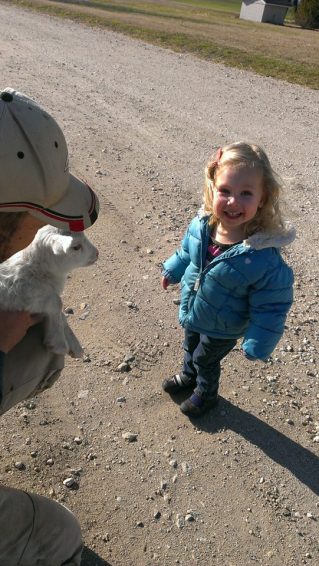
Earlier that morning Jason discovered that one of the lambs in his care had been orphaned. The mother had given birth for the first time and to twins, and as is often the case with ewes, she bonded with one and rejected the other.

So Jason took to feeding this lamb with a bottle every couple of hours. And since it was Sunday, he knew he would have to feed this lamb between worship and Sunday school.

Word got out that there was a lamb on church property and pretty much everyone flocked outside to have a meet and greet with this precious creature, lambo as he was affectionately named.

No one could believe the fact that these two events coincided. On Good Shepherd Sunday one of our congregants brought a lamb to church.

I decided to call Jason this week to talk about all things sheep. I asked Jason whether it’s true that sheep require more attention and meticulous care, more handling, and more detailed direction than any other class of livestock. Sheep get a baaaad rap you know. They have a reputation for lacking intelligence of any kind. And so when we as people are compared to sheep as is often the case in the Bible, it should give us pause; it’s not a compliment.

Jason doesn’t entirely agree with this description of sheep. Sure, he said they can be a pain in the ewe know what. Sheep are stubborn, they are creatures of habit, easily panicked, sometimes timid, and they lack intelligence at times. They can be ornery and moody. In addition, there’s a lot of rivalry, tension, and competition in his small herd. He recalls when two ewes butted heads for two days straight until they were bleeding. (Not too unlike my sister and me when we were younger.)

So yes, Jason said they might be considered a high-maintenance class of livestock. And yet Jason speaks fondly of his small flock. He still has his four original ewes that he started with four years ago when he started sheep farming. He says that each of the sheep have individual and distinct personalities. And instead of just assuming they are stupid creatures like many do, he would say they are vulnerable. Sheep, he said, have the highest levels of pain when they are injured. They are extremely sensitive to sickness and injury and prone to infection and illness. They are lower on the food chain, vulnerable to predators like coyotes and hawks. And so one of the reason they flock together is because there is sometimes safety in numbers.

I’m not entirely sure why I wanted to return to Psalm 23 in this stretch of time following Easter. Perhaps I wondered what it would be like to explore this Psalm from more of an urban, city experience.  Or perhaps I wanted to dwell with Psalm 23 because we all know a little something about vulnerability. We know what it is like to feel scared and timid. We are sometimes prone to stick with the pack out of fear or concern for safety. Many of us carry deep concerns about our futures: our finances, our safety, and well being. We all feel helpless at times in the face of danger.

Most of us do not say “I shall not want,” and mean it. We want and desire all kinds of things. While we may long for green pastures, cups that overflow, tables wide enough for enemies, too often we walk in shadows, all too aware of lurking dangers. Too often the enemies destroy the tables where we might have gathered. Our souls are not at rest. Many of us are plagued with worries, injuries, concerns that keep us up at night or keep us sleeping during the day. We so often feel fragile, vulnerable, prone to disease and dis-ease. Some are even neglected with no mother to feed them. By the way, I asked Jason whatever happened to that lamb he bottle fed and he said for several weeks after that, lambo slept in their house. Now he has two human children he’s feeding so I don’t think that lambs have the same house access (I could be wrong).

What strikes me about Psalm 23 as it is presented in the Bible is that even though it’s often read at funerals, the metaphors and images that the psalmist used are mostly about the present, not the future. Psalm 23 speaks of God’s relation to our living our everyday lives. That’s what I hope this series on Psalm 23 will help us reflect on-God’s relation to our living our everyday lives.

One of the Psalm 23 adaptations that I have carried with me for the past four years is written by Murphy Davis, a partner at the Open Door Community in Atlanta Georgia. I do not know Murphy Davis personally but I know people who live with her. For the past 15 plus years, Murphy has lived with Non-Hodgkin’s lymphoma. Her adaptation of Psalm 23 grows out of her experiences over the years as a social activist living with illness and physical limitations. I think it speaks of movements of consolation and desolation, strength and vulnerability.

My Beloved Friend,
you are my shepherd.
In your care I have everything I need.

You open the gate to green pastures,
you teach me Sabbath,
and give me time to rest.

Beside the flowing stream
and the still lake
you restore me to myself in your image.

You lead and accompany me
into the path of justice and solidarity,
and I find my integrity in your way.

Even though I walk through
the Valley of the Shadow of Death,
I am not afraid,
because you never leave me
and your love casts out fear.

With a shepherd’s rod and staff
you guide me and give me comfort and strength.

You invite me to a bountiful table
where enmity and divisions fall away.

Justice is important;
but supper is essential.
You welcome me as an honored guest.
My joy overflows like a cup
poured full and always
spilling over.

Your goodness and mercy have
run after me my whole life long;
and so I will enjoy living
in the light of your presence forever.


Posted in Uncategorized | Leave a comment

A Baseball Psalm by Joshua Chittum

This coming Sunday we’re starting a new worship series on Psalm 23 just as the Kansas City Royals start a new baseball season. At the risk of confusing sports for religion, I asked Rainbow congregant Joshua Chittum to reflect on Psalm 23 using baseball imagery/language. Consider this our Psalm 23 opening pitch.

Video produced by the Sub-Committee on Baseball Psalm Liturgy Task Force (SCBPLTF), featuring Royals Fan of the Game Hannah Unruh and Westwood Park.

Posted in Uncategorized | Leave a comment

Resurrection lite or resurrection light?

Today I am reminded of what Michelle Webster-Hein once wrote:

This morning at church I plunked out the four parts of an old hymn while above my chords the congregation’s voices took flight. And I thought of geese bursting up together from the edge of a pond where they had been napping and squabbling and pecking for fish.

Sometimes it is hard for me to believe in God, heaven, restoration, but it is easier on Sundays, when the Mennonites sing, to suspect that goodness is always paddling about at the edges of things.

“Goodness is always paddling about at the edges of things.” Now that to me is a good word for Easter.

Believe it or not, it’s not easy to know what words to say (or not say) on a morning like this. I think a lot of you sensed that because I got a lot of “I’m praying for you” emails this week. Thank you for your prayers.

Ever since I was little, our family began Easter outside at an Easter sunrise service. Easter began with the stillness  and quietness of the morning. The sun did the work for us as we watched, waited and listened. I actually think Jesus’ resurrection is best considered outside. There’s more room to explore and imagine when you are outside near a garden, near water and rocks with the sound of birds and the sun peaking over the horizon. Plus, the majority of the resurrection stories found in the Bible take place outside.

For six years when I was the pastor at Bethel College Mennonite biked 5-6 miles to the Easter sunrise service with the youth group, sometimes as early as 5 am. It was only later in the day that we gathered to raise our voices in a sanctuary setting. But again, thinking about my growing up years, I didn’t have to use very many words back then. In my family my sister and dad did most of the talking while my brother and I did the trumpet playing and my mom organized the Easter dramas. This was fine by me. I was much more comfortable playing trumpet than thinking or talking about the theological implications of Jesus’ resurrection.

IMG_1399I’m not sure why, but this year I found myself wanting to play the trumpet again. Or at least I wanted to see if I could play the trumpet again and of course I made the mistake of saying this out in front of our Music Ministries Director Rosi and within a day, there was a trumpet waiting for me in my office. Perhaps I wanted to play trumpet again because I feared I wouldn’t have words today. A pastor should always have a back up plan.

This week several people asked me if I enjoyed preaching at Easter. A couple people even asked me if I ever had to fake believing in the resurrection-a bold question to ask a pastor, but I appreciated it nonetheless.

I’ll admit that it does at times feel daunting and even presumptuous to proclaim the resurrection of Jesus from death. I tend to be among those pastors who are a little more comfortable with quiet, hushed alleluias at Easter than bold, triumphant shouts from the mountaintop. Sometimes , some years I prefer to go lite on the resurrection.

I can relate to what pastor Russell Rathbun writes:

On this Sunday, Easter Sunday, I am always a little intimidated to get up and say anything, especially such a clear and remarkable thing. How do I talk about the actuality of this event that we are re-membering, the coming back from a murder perpetrated by God’s creations, which serve not as evidence for our condemnation, but as the advent of our reconciliation, our new birth as a humanity?…

No matter how much joy and exuberance I try to summon on a day like this, he writes, it always feels inadequate in its aim and size.

I imagine it’s not just pastors who can relate to this. It’s difficult to know what to say or not say on a day like this. It’s intimidating to know what questions are acceptable to ask in church. We’re all trying and struggling to frame this impossible-sounding, even offensive-sounding notion of bodily resurrection. Sometimes on a day like this it’s difficult in church community to give each other the enough space to explore, dream, and imagine, affirm, and yes, question. Sometimes we become so convinced that Jesus’ resurrection did or did not happen, or that it means this and not this, that we stop exploring and imagining and listening to one another.

I tend to  agree with writer Nora Gallagher who fears that we spend so much time in the church debating whether the resurrection did or did not happen and in our debates, we sometimes miss the point entirely. What if, she wonders, we spent more time asking ourselves what the resurrection points to, and what Jesus’ post death appearances ask of us…for it is, and I quote her, “finally what we do with these accounts that matters. Will we make them into superstition or use them as stepping stones to new life here and now?”

12524242_10208346841404095_8630154306217991379_nI thought this week about Bonnie Beachey, a beloved member of this congregation who died in January. The service we held in her honor did not begin with words. It began with her grandson rising from the pew, walking with great care to the front in order to light a candle. There was a note in the bulletin that said the white candle symbolized Bonnie’s baptismal vows and the flame represented hope and faith in eternal life.

I was so moved as I watched him carefully light this candle in honor of his grandmother. As I watched him light this resurrection candle, I found myself wondering again about this notion of resurrection–this grand undoing of death that the Bible describes, and that the church through the ages, that Bonnie sought to live and trust. I found myself wondering again, asking myself what I resisted about the resurrection, or why at times I chose to treat the resurrection more lightly.

And then this week my mind wondered to my time spent in one of the children’s Sunday school rooms about six weeks ago. I was collecting their questions about Jesus, the Bible, the church, etc. It was Joel Bollinger who finally spoke up. It took him a little while to feel comfortable asking it but finally in a slow, thoughtful way he said,

If someone dies (long pause), this might sound weird, (another pause), but if someone dies are they considered recreated? If so, what kind of recreation?

These are times I feel woefully inadequate as a pastor and wish I would have pursued trumpet performance instead.

Because this question gets at the heart of what we are invited to wonder about and consider on a day like this.

question

Joel, and to anyone else who have wondered about such profound things, I believe that the God we worship is a God who is always at work creating and recreating. The story as passed on to us through the ages goes that not even death can entomb God and not even death can entomb us. In all things, even in death, God is at work redeeming, renewing, restoring and yes, recreating-putting back together that which feels lost forever, broken, and torn apart.

How that putting back together happens, when that happens, why that happens is what we are invited to reflect on our whole lives and in community. More than that, recreation is what we are invited to practice as the people of God. Jesus’ resurrection, whether we believe in it or not, points to much more than the miracle of a dead person raised from the grave. What I believe the resurrection points to is that all of the principalities and powers that seek to entomb God and entomb us, all of the hatred spewed in our world, all the injustices, all that would keep us down-these things may appear to have the last word, these things may have us doubt in the presence of God but the good news of Easter worth considering is that these realities do not and will not have the last word. And they won’t have the last word because the Spirit of God continues to empower people and communities who refuse to let hatred have the last word. The always creating Spirit of God is breathing life into people, into places, yes even into death in all its forms, awakening us, awakening a new world of peace and harmony and equality and mutuality, about which we can only dream at times.

Might we come together or at least consider that piece of good news? Might we become people who seek to walk in the light of the resurrection believing together, or helping each other believe that goodness is always paddling about at the edges of things? Let’s continue to pursue that goodness. Let’s continue to let that goodness guide us in walking toward this new world of peace and equality and mutuality.

Posted in Uncategorized | Leave a comment

Room at the tomb

FullSizeRender(1)

Photo credit: Jan Buerge

“If it’s ok pastor, I’m going to say Christ is risen indeed with everyone else, but I am going to say it as a question rather than as an answer.”

No problem, I thought. In fact, anyone who hesitates to proclaim Jesus’ resurrection with absolute, unwavering certainty will find good company in the scriptures (and at Rainbow). From the very beginning until now, the rolled away stone has elicited more questions than answers, more doubt than certainty.

There is, I trust, room at the tomb for all of us—questioners, skeptics, believers, followers— as we consider how God might be at work rolling away the various stones that would destroy us.

And so as Easter draws near, my prayer is that we will permit ourselves and one another to explore, imagine, and question. And maybe just maybe in showing up at Easter we will consider together how God might be at work in this world healing, redeeming, and restoring all that is entombed, all that appears dead. And maybe just maybe we will be inspired to carry on this restorative, redeeming, life-giving work.

Posted in Uncategorized | 2 Comments

The cross revisited

When I was a pastor-in-training at Belmont Mennonite Church in Elkhart, IN, I was asked to plan and lead a Good Friday service. I quickly felt in way over my head. More than that, I felt spiritually and emotionally dispirited and disconnected, even angry. So much of Christian theology and accompanying worship liturgies and hymns make God out to be a sadist who inflicted punishment and Jesus a masochist who willingly endured suffering. Would it be possible to plan a service in a way that didn’t glorify suffering and steered clear of the suggestion that salvation requires blood and sacrifice? And was it even ok for this pastor-in-training to ask such questions?

At that time I was reading an article written by one of my seminary professors Mary Schertz called God’s Cross and Women’s questions: A Biblical perspective on the atonement. “To use any image of death and destruction,” Schertz writes, “as a root metaphor for Christian faith, no matter how clothed in piety of theological language, raises issues for any group of people who have internalized negative self-understandings… Frequently—to their own detriment—women have internalized the motifs of suffering that have sometimes been glorified in Christian faith and have accepted suffering as their lot.” (This article was published in Mennonite Quarterly Review 68, 1994)

Fast forward 15 years, and some days I still feel like a pastor-in-training as I struggle to articulate my theological understanding of the cross and Jesus for that matter. I still feel dispirited at times sifting through the varied theologies and reflections, especially related to Holy Week. Again and again, I find myself returning to Schertz’s writings:

“The kingdom that Jesus proclaimed was not a realm founded upon or maintained by violence. The death of Jesus, then, was inevitable only because it constituted an act of integrity within the framework of his commitment to the reign of God which he proclaimed.”

IMG_1067In other words, the death of Jesus was and is salvific because it was part of how Jesus proclaimed and enacted God’s non-violent love in the world. Jesus was so committed to an alternative way of living that even when people resisted him, he went forward anyway refusing to violently resist those people who violently opposed him. The question for us then becomes what does it mean to follow this Jesus? What alternative ways of living are made possible by Jesus, or made possible through the church?
I will have a copy of Schertz’s article in the Sanctuary this coming Friday, along with other Good Friday prayers and readings. Feel free to spend time there reflecting, praying, or simply sitting alone in silence anytime between 9 am-9 pm. And don’t forget about our Maundy Thursday agape meal from 6:30-8 pm. Please RSVP by clicking here. We will hear the story of Jesus’ Last Supper with his disciples, share in communion around the tables, sing some hymns, and enjoy a meal of soup of bread. And perhaps each table can spend some time discussing these Holy Week questions/observations offered by our young congregants. Better yet, there will be a young person at each table leading such a discussion!

IMG_1348


Posted in Uncategorized | 1 Comment

Here a Bethel makes

And though when evening falls, a stone my pillow shapes, the vision of our kingdom calls and here a Bethel makes.

Every time I sing these words from a hymn called “In lonely mountain ways” (Hymnal: A Worship book #580), I feel nostalgic for my alma mater Bethel College located in North Newton, KS.

The Bethel in this hymn is not of course referring to the four-year Mennonite liberal arts college in KS, nor is it referring to the Evangelical Bethel College in Mishawaka,IN. Bethel, long before it was a college, was a town north of Jerusalem featured prominently in the Old Testament. Bethel, which in Hebrew means “House or household of God,” is where the Hebrew people met and deepened their connection with God. More specifically, Bethel is where  Jacob dreams of a stairway to heaven (long before it was a rock song), with angels ascending and descending on it, and the Lord standing above it (Genesis 28:10-22).

Lest we at Bethel begin to feel smug about our school name, Bethel was also a place of idol worship and corruption, at least according to the prophets. Students at nearby Mennonite Brethren-affiliated Tabor College took pride in referring to Bethel as Beth-HELL, while holding up signs quoting Amos 4:4: Go to Bethel and sin!” (I don’t know what this says about me, but I felt extra proud when draining three-pointers right in front of these sign-holding Tabor students.)

It might sound presumptuous to think of one’s alma mater as “The House of God.” Then again, the Bethel household, meaning the people that make up this community, continue to enrich my life and my ever-evolving connection with God. This household continues to travel with me even when I’m far away from its physical campus.

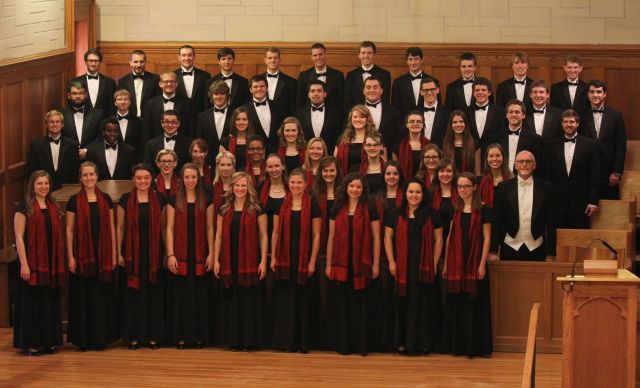
Speaking of this traveling household, a small, but significant part of the Bethel community  will be at Rainbow this weekend in order to lead us in our Palm Sunday worship service.

Concert Choir 15-16

2016 Bethel College Concert Choir. Photo credit: Vada Snider

I never sang in the Bethel College Concert Choir (I was too busy trying to make three pointers), but much like our Rainbow Choir, I feel a deep connection, a deep yearning for God, every time I hear them sing.

Who knows? Maybe this Sunday we will have our own visions of a stairway to heaven with angels ascending and descending on it. Who knows? Maybe Rainbow will a Bethel make.

For additional reading about the Concert Choir, click here: Concert Choir press release


Posted in Uncategorized | Leave a comment